


Every Friday I read the week’s signals from two sources, the investments of early-stage investors and the findings of research institutions, the same evidence base my annual report on AI and work is built on. The investors are never the story. Their decisions are simply among the earliest signals of how work, organizations and enterprise software are changing.
For thirty years, enterprise software competed for the software budget. The new competition is for the labor budget, the half of corporate spending that pays people, and a product that competes for that budget is not judged like a tool. It is judged like a colleague, on whether the work got done. Last week the market put a twelve billion dollar price on converting organizations from the inside. This week the investment thesis behind that price was written down in full.
The product is no longer the tool, it is the work
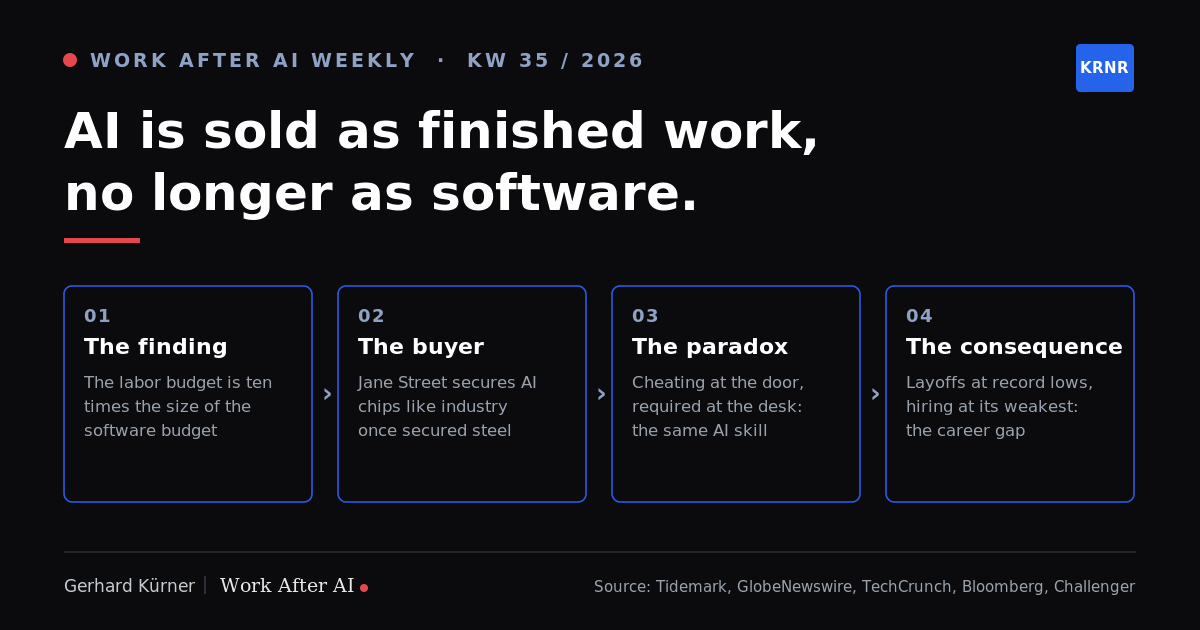
The most instructive text of the week is not a funding announcement. Tidemark, the growth investor behind ServiceTitan, published a long essay in recent days arguing against the fashionable view that the application layer of software is dead now that models can do everything. The argument runs the other way. Intelligence alone books no revenue and chases no invoice. Someone has to connect the model to the workflows, the data, the permissions and the accountability of a real business, and whoever owns that connection owns the customer. The firm puts numbers on the prize, and they are its own numbers, so they should be read as a thesis rather than a measurement. Labor, it calculates, absorbs roughly ten times more corporate spending than software. Eighty-three percent of the buyers it surveyed would switch to an agent offered by their existing system of record even if that agent were only eighty percent as good as a specialist product. And the model laboratories themselves, by Tidemark’s count, have already committed on the order of ten billion dollars to service organizations, which the essay reads as an admission that the models alone do not finish the work.
Put next to last week’s two billion dollar raise for buying and rebuilding accounting firms, the picture is consistent. The scarce asset is not intelligence. It is the installed, permissioned, accountable path from intelligence to a completed piece of work.
Work done by machines needs a supply chain
If work is increasingly performed by machines, the inputs of work change. What payroll and office space are to a human workforce, energy and computing capacity are to a digital one, and this week the market treated them exactly that way. Etched, the maker of a chip specialized for one model architecture, raised seven hundred million dollars on August 18 at a twenty-one billion dollar valuation, double its valuation of a month earlier. The detail worth pausing on is not the number but the buyer. The round was led by Jane Street, the trading firm, which is simultaneously the first customer and has already taken delivery of the first rack. A firm whose product is decisions per second is securing its supply of inference the way industrial companies once secured their supply of steel.
The same logic showed at the edges of the window. Panthalassa, which builds wave-powered compute platforms at sea, closed a round of roughly 225 million dollars at nearly two billion on August 13, one day before this window opened, and earlier this month Valar Atomics raised a billion dollars, led by Sequoia, to build nuclear power for exactly this demand. Last week this series covered price indices and futures curves for computing capacity. The thread is unbroken: the procurement department, not the IT department, is becoming the place where a company’s capacity to employ machines is decided.
The machine worker gets an administration before it gets a job description
The third pattern sits closer to the org chart. In the days just before this window, three companies raised money for what can only be called the administration of a digital workforce. Sapiom raised thirty-five million dollars on August 5, with Anthropic among the participants, for a runtime that gives every machine worker budgets, permissions and an audit trail before it is allowed to execute anything. Actualyze came out of stealth on August 3 with seven million dollars, backed among others by Canaan, to route every AI request in a company through access rules and spending controls. And Axle raised seventeen and a half million dollars around August 13 for agents that already handle verification and monitoring work in the insurance back offices of Rocket Mortgage, Avis and Experian. None of these rounds is large. Together they say something large: organizations are building the personnel administration for digital staff, identity, entitlements, cost centers, oversight, before most of them have decided what the digital staff’s actual job is.
The same skill is cheating at the door and expected at the desk
There is a contradiction sitting at the entrance to every professional job right now, and almost nobody names it. Fabric, an American vendor that sells machine-conducted job interviews with built-in cheating detection, published an analysis of 19,368 of its own interviews earlier this year. It flagged 38.5 percent of candidates for suspected AI assistance, technical roles at 48 percent against 12 percent in sales, and beginners at roughly twice the rate of experienced candidates. Read those numbers carefully, because the company itself does not. A flag is a suspicion above a probability threshold, not a proven deception, no false-positive rate is disclosed, and the vendor earns its living from the quantified suspicion. What the numbers do establish is a direction, and the direction is unmistakable.
Now put that next to what the same candidate meets on the first day of the job. Shopify’s founder wrote in an internal memo, later published, that reflexive use of artificial intelligence is a baseline expectation, and that before any team may ask for more people it has to demonstrate why the machine cannot do the work. So a candidate is screened out at the door for using the tool, then hired into an organization that requires them to use it and asks them to justify their existence against it. The same capability is a disqualification in the interview and a job requirement at the desk. That is not a moral failure on anybody’s part. It is what happens when the selection process still tests for the old job while the work has quietly become the new one.
Signals at the margin
Defense continued to absorb capital at industrial scale: Castelion raised a billion dollars on August 19, co-led by JPMorgan, Andreessen Horowitz and Carlyle at a thirteen billion dollar valuation, part of it a credit facility, to mass-produce a low-cost hypersonic missile. And the American labor market delivered the week’s quietest but most important number. Initial jobless claims fell to 206,000 in the week to August 15, historically low, while hiring runs at its weakest pace in years, and the outplacement firm Challenger, Gray and Christmas has now recorded artificial intelligence as the most frequently cited layoff reason for five months running. Companies are not firing their people. They are hesitating at the door where new people come in.
The week at a glance
Etched: 700m at a 21b valuation on August 18, led by Jane Street, which is also the first customer. Compute is procured like a raw material.
Panthalassa: roughly 225m Series C on August 13, co-led by 8090 Industries and Hanwha Asset Management. Compute goes where the energy is.
Valar Atomics: 1b Series B on August 4, led by Sequoia. The digital workforce needs its own power supply.
Sapiom: 35m Series A on August 5, led by Dragonfly, with Accel and Anthropic among the participants. Budgets, permissions and audit trails for machine workers.
Actualyze AI: 7m seed on August 3, with Storm Ventures, Canaan, Morado and AME Cloud. Every AI request routed through rules and spending controls.
Axle: 17.5m Series A around August 13, led by Base10, with Gradient. Insurance back-office work moves to agents.
Castelion: 1b Series C on August 19, co-led by JPMorgan, Andreessen Horowitz and Carlyle. Defense industrializes autonomy.
Tidemark: an essay rather than a round, “The Case for the Application Layer”. The labor budget is the new software market.
What this says about the career gap
Follow the patterns to their common destination. If software is sold as finished work, the work it takes over first is the work that is easiest to specify, and that is disproportionately the work organizations used to give their newcomers. The same week in which an investor calculated that the labor budget is the real market, the labor data showed where that market is being entered: not through layoffs, which are historically rare, but through hiring that quietly does not happen. The adjustment is almost invisible from the outside, because nobody is dismissed. It is highly visible to one group, the people trying to get in, and they are the same people being flagged at twice the rate for using the tool their future employer will require of them.
My annual report, Work After AI, appears this autumn and calls this force the career gap: the second of the three forces that decide how work actually changes, and the one that operates at the entrance of the labor market rather than in the middle of it. The report examines what happens to professions when the routine work that once trained beginners is the first work the machine takes over, and what organizations that still intend to have experienced people in ten years are doing about it now.
Reading the week
None of this is a scoreboard of who invested how much. The deals matter here only as evidence, and the evidence of this week points one way. The market has stopped treating artificial intelligence as a product category inside the software budget and started treating it as a labor supply with its own raw materials, its own administration and its own price. Organizations will feel that shift first not in their technology, but in their hiring plans. Whoever waits will find that it was there all along, and that they did not see it coming.
Gerhard Kürner is CEO of 506.ai, the European platform for Service-as-a-Software and agentic engineering, and author of Work After AI. Around 1,000 conversations with boards, owners, and PE funds across DACH and Europe.