


In five trading days in February 2026, roughly 1.2 trillion US dollars in software market cap vanished. The ten largest names in the IGV index lost close to 800 billion since the start of the year. The financial press called it SaaSpocalypse. Wall Street called it panic.
Goldman Sachs called it something else. Goldman Sachs called it overdue.
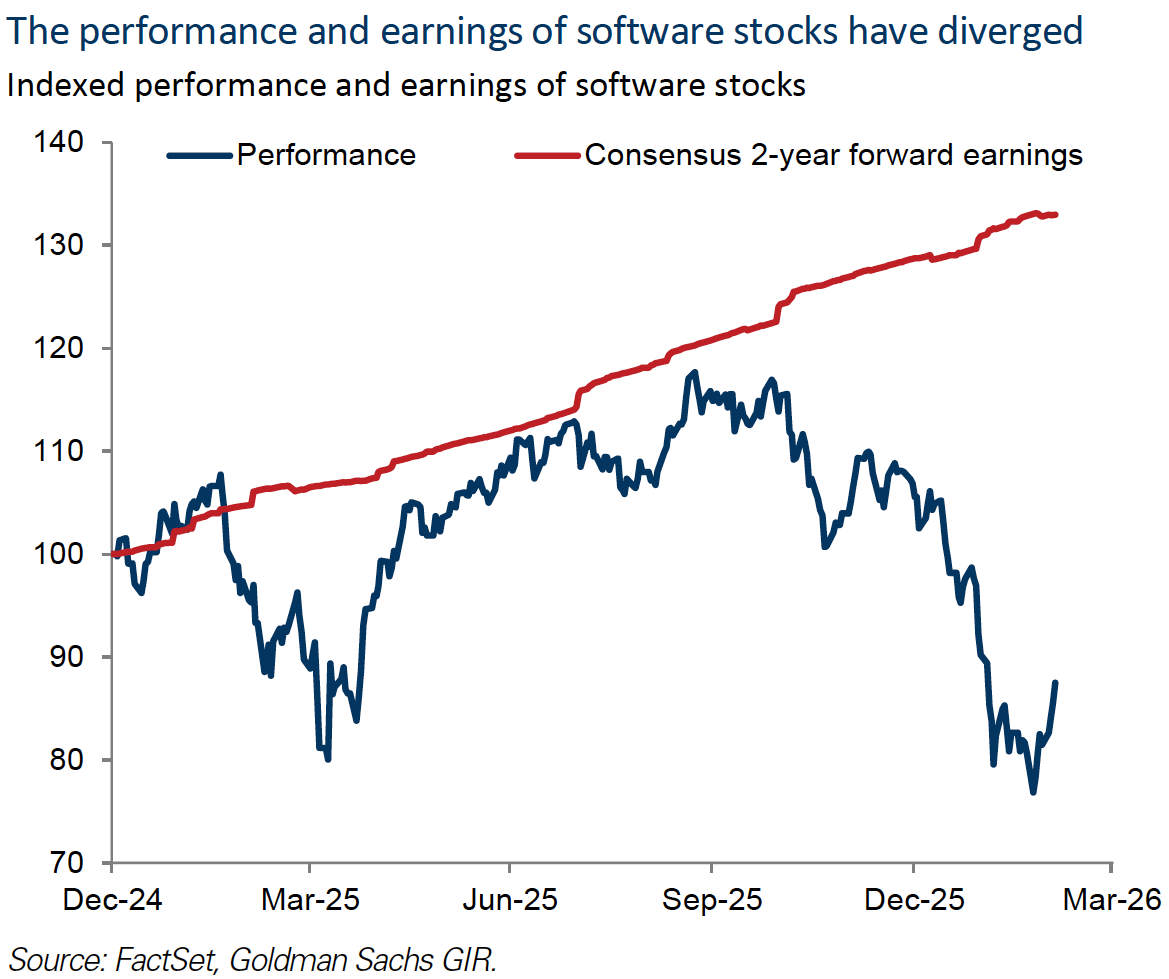
What the report actually says
Gabriela Borges from Goldman, Rick Sherlund, and Sanjay Poonen, CEO of Cohesity and former President of SAP, agree on more than you would expect. AI is not eating software. AI IS software. The market does not shrink, it expands. The total addressable market grows, not falls.
And yet the panic is not an overshoot. It is the market pricing in a new reality.
Three points all three experts make directly or by implication:
Price per user is collapsing. If one AI colleague does the work of five analysts, nobody buys five licenses.
Legacy systems do not need optimization. They need to be rebuilt. Bolt-on AI is marketing, not product.
Incumbent moats buy time, not immortality. Sherlund puts it plainly: “AI will very likely erode them over time.”
John Zito, Co-President at Apollo, said the uncomfortable part even more bluntly on CNBC in February: “The marginal cost of producing software is moving toward zero.” That is not a forecast. That is a financial statement from one of the largest private equity houses in the world.
The real message sits one layer deeper
Software will be used many times more in five years than it is today. At the same time, it will be many times cheaper to produce. That is the uncomfortable equation:
More software. Much more. And every single euro of it will be harder earned.
This equation breaks the classic SaaS logic: high margins, sticky customers, recurring revenue, per-seat pricing. Fortune lists the three forces dismantling the model: switching costs as artificial anchors, collapsing barriers to entry through AI coding agents, and the redefinition of workflows through autonomous systems. None of these forces is speculative. All three are already in the market.
Anyone who still thinks this is a product management topic at the software vendor has not understood where the wind is blowing from. This is a topic for every CFO, every CIO, and every supervisory board in every company that uses software. Which is every company.
Why legacy organizations will not keep up
This is where it gets genuinely uncomfortable for established European enterprises.
The instinct of many boards: “We have legacy code. We will modernize it with AI.” McKinsey promises 40 to 50 percent faster modernization. HFS Research points to 30 percent cost reduction. Sounds great.
It is also not the problem.
The problem is not the legacy code. The problem is the legacy organization wrapped around it. Poonen says it almost in passing in the Goldman interview, and it is the most important sentence in the entire report: “The bigger the install base, the tougher it is to pivot.” Or even more directly: “God created the world in seven days because he didn’t have an install base.”
Install base here does not only mean software. It means processes, roles, budgets, works council agreements, supplier contracts, job descriptions, bonuses. It means the entire organization that was built around the old software.
AI modernization of code is technically solvable. Breaking the organizational structures built around it is not.
This is the point where consulting, support, and offerings hit their limit. You cannot teach an organization to outpace itself while its incentives are wired to keep the old operation stable. Sometimes the organization has to break before it can be rebuilt. That is uncomfortable. It is also not negotiable.
The PE dimension: European investors are getting nervous
This is the part most European boards have not yet put on their radar.
Private equity has deployed roughly a quarter of its total volume into software over the past five years. In the 2021 and 2022 vintages, software assets were acquired at 15 to 20 times revenue, with leverage ratios of 6 to 7 times EBITDA. The assumption: stable retention, predictable growth, premium multiples at exit.
That assumption is dead.
Bloomberg reported in late February: secondary market buyers are demanding up to 20 percent discounts on PE software portfolios. A few weeks earlier, it was 5 percent. S&P Global counts 130 billion US dollars in software acquisition loans trading below 90 cents. That is the zone where equity is already impaired. PitchBook openly calls it a “Software Reckoning” in its current Analyst Note.
For European corporates that are majority PE portfolio companies or have PE investors on the cap table, this translates concretely:
LP patience is gone. The Distribution Drought model from Allianz forecasts a range from minus 3 to plus 8 percentage points in distribution rates for 2026. The difference between the top and bottom of that range: whether the software assets in the portfolio become AI capable, or have to be written down.
What this means: if your company has a PE investor, this conversation is coming to the table in the next 12 months. Not as a strategic option. As pressure. LPs want DPI, not IRR. Exits want multiples, not stories. And multiples only go to companies that can tell a credible AI value creation story. PwC puts it coolly: “The ability to articulate a credible AI value creation story is no longer optional. It is a prerequisite for liquidity.”
For European companies this is both an opportunity and a threat. Opportunity, because capital on reasonable terms will flow into AI native transformation. Threat, because companies that do not move will either be written down or sold. At discounts, to buyers who mean it more seriously.
What to do now
Offerings and support are the easy part. Every consulting firm, every software vendor, every system integrator now has an AI offering. That is not the bottleneck.
The bottleneck is the willingness to attack your own organization before someone else does.
Three moves every leadership team should initiate in the next 90 days:
First, an honest inventory of all software contracts. Which tools are still paid per seat for work that could already be handled by AI colleagues? This is not a procurement exercise. This is strategic repricing.
Second, a brutal inventory of the processes that exist not because of software but because of organizational history. Who protects which process because their job depends on it? That is the real technical debt.
Third, a decision: bolt-on or rebuild. Poonen calls it “living in the old house while you build the new one next door.” Sounds comfortable. It is not. Because the old house must come down once the new one is ready. Most organizations fall too much in love with the old address.
Closing the bracket
Goldman Sachs writes that the numbers must contradict the story before markets can stabilize. That is correct. But it also applies to the other side.
The story is not that AI is eating software. The story is that AI is eating the existing business model of software while the amount of software itself is exploding.
Read from the investor perspective, this is an 800 billion dollar loss. Read from the perspective of a European CEO, this is an invitation. A brutal, short invitation to turn your own organization into a company where humans and AI colleagues work side by side. Not in three years. Now.
In five years, every enterprise that still exists will run hybrid teams. The question is not whether. The question is who builds those teams: the company itself, or a buyer at a discount.
Gerhard Kürner is CEO of 506.ai and Co-Founder of Choose European. 506.ai builds digital teammates for European enterprises and the public sector with Kollega, hosted in the EU, GDPR compliant, designed for hybrid teams of humans and AI. Everyone taking enterprise AI transformation seriously finds the entry point at mykollega.ai.