


A new study from Stanford and Imperial College measures how fast the internet has been rewritten in three years. The number confirms what was already discernible in the summer of 2025 to anyone connecting the right indicators. The full scope of this speed remains systematically underestimated in European boardrooms.
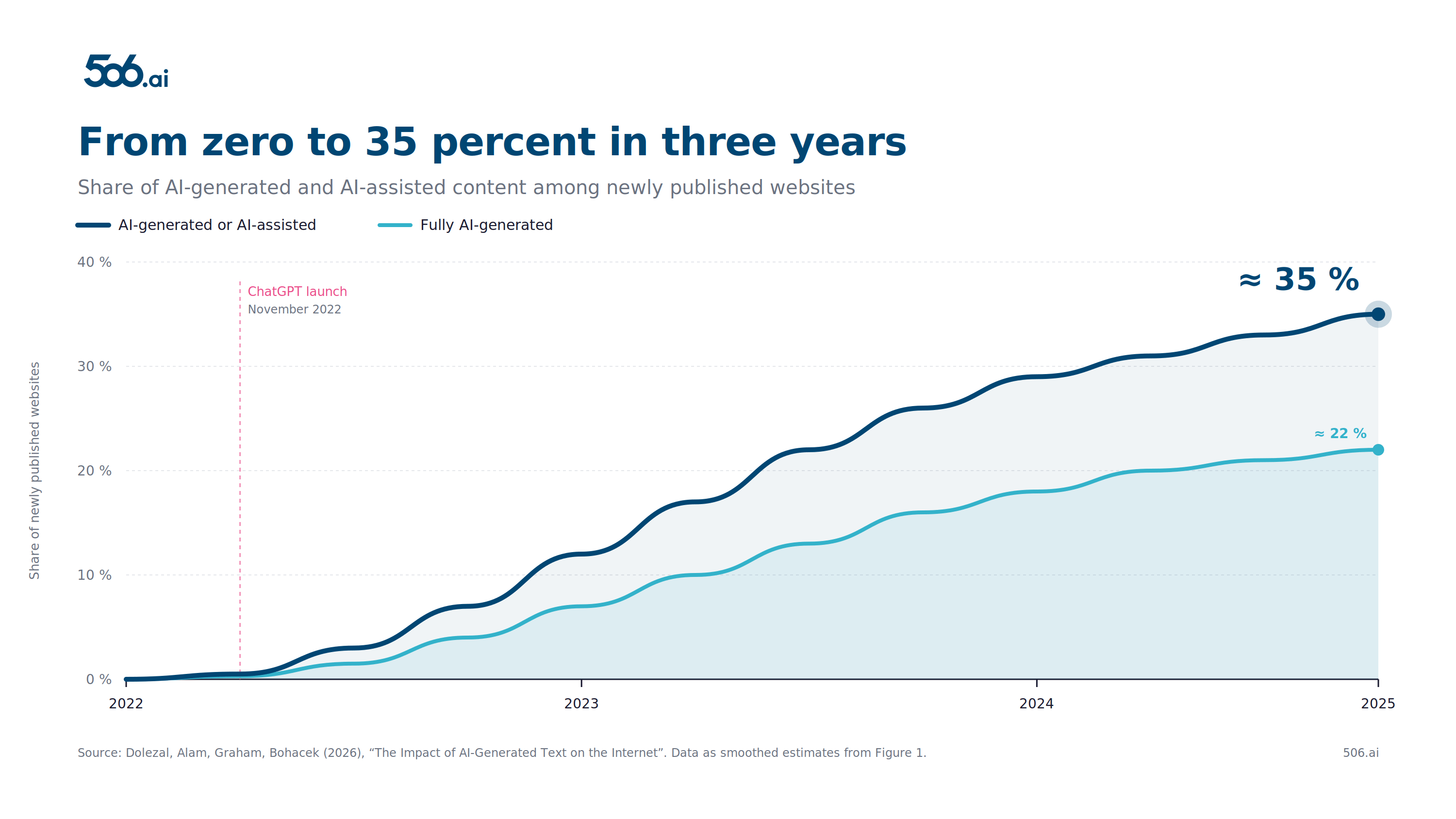
In April 2026, a team from Imperial College London, Internet Archive, and Stanford published a paper that has so far gained surprisingly little traction in the broader business discussion. The paper is titled “The Impact of AI-Generated Text on the Internet” and delivers the first robust empirical measurement of how large the share of AI-generated content on the open internet has actually become.
The headline number: 35 percent.
35 percent of all newly published websites in mid-2025 were either fully AI-generated or AI-assisted. In November 2022, before the launch of ChatGPT, that share was zero. In three years, roughly one third of the publicly accessible internet has flipped, measured against a representative sample rather than extrapolated from industry surveys.
The number itself is not the truly remarkable finding of the study. What is remarkable is the speed at which this shift has happened, and the fact that it has remained practically invisible to most companies.
What the study now confirms was already discernible twelve months earlier
In the summer of 2025, I conducted strategic analyses for several industries, all converging on the same trajectory. Anyone who at that point combined the adoption curves of mainstream AI tools, the publication frequency of new coding agents, and the rapidly falling unit costs of synthetic content could compute the next twelve months cleanly. The conclusion at that point was not speculative, it was arithmetic.
What the Stanford and Imperial paper now delivers is therefore not new information. It is the retrospective validation of what was already visible, provided one had connected the right indicators. This is precisely where the actual strategic problem begins, because the majority of executive teams do not perform this connection.
The scope is the variable, not the direction
In more than 1,000 conversations on AI and software integration with executive boards, supervisory boards, investors, and management teams, I have observed a consistent pattern over the past twelve months. The direction of change is broadly accepted, no one seriously disputes that AI is changing business. The scope of this change, however, is being systematically underestimated, not by ten or twenty percent but by entire orders of magnitude.
This is the observation that the paper indirectly confirms. Anyone who cannot measure the speed of an ongoing restructuring is also not in a position to address it. And most organizations simply do not measure.
Where the scope gets lost
In the summer of 2025, I had a conversation with a long-standing business partner and friend. His business consists of e-commerce and website creation for SMEs, a solid model with a good customer base and a classic mid-market profile.
My analysis at the time was simple in substance. Website creation will, within a window of twelve to eighteen months, no longer be a meaningful cost or time factor, but will become effectively free and accessible to anyone. The economic value therefore shifts from building to customer access. Whoever holds the customer can offer them adjacent services that take work, time, and cost off their plate. Whoever loses the customer no longer has a bridge to the next layer of value creation.
The strategic recommendation was correspondingly clear. Build a second line, immediately, with fully automated website creation positioned as customer access rather than as product, and from there derive the next service layer. The window was twelve months.
My friend believed me in principle. We have known each other for a long time, the trust was there. But the scope I described, he did not see.
He and his partner subsequently automated, did clean work, and built their own solution. However, they set up the project as an optimization of the existing model rather than as the construction of a new value creation architecture. The urgency was not translated into architecture, which in economic terms is the same effect as no movement at all.
Eight months later the market is a different one. Coding agents and agentic systems today form a complete stack that did not exist in this form in the summer of 2025, and what was then considered demanding automation is now entry level. The next wave is already clearly visible in the indicators. It will no longer be about websites, it will be fully agentic, and it will arrive within a horizon of six to twelve months.
Three waves arriving in short succession. Whoever misses one catches up with significant effort. Whoever misses two has a different business. Whoever misses three is no longer part of the market.
The European defensive line is built in the wrong place
The typical reaction in European boardrooms follows a stable pattern that condenses into a few sentences. “That is the US. Here it takes longer.” This position is not analytically tenable.
The paper analyzed exclusively English-language websites, and no comparable study yet exists for the German-speaking market. The assumption that adoption here proceeds substantially more slowly is therefore exactly that, an assumption, and not a measurement. What is genuinely slower in Europe is decision-making within organizations, an endogenous variable rather than a market characteristic. The markets themselves do not adhere to the schedules of board meetings.
Whoever confuses speed with geographic distance defends along a line where the threat does not actually originate.
The starting advantage that is currently expiring
This is where the strategic point sits, the one missing from most discussions. Established companies with an existing customer base, accumulated domain knowledge, and a functioning sales structure hold a historic starting advantage in the current transition over AI-native startups, larger than in any previous technology wave. The reason is arithmetic: building a solution has become drastically cheaper, building a customer base has not.
This inverts the classic startup logic. For decades, the rule was that better technology beats established distribution over time. In the current phase, established distribution beats any technology that can be replicated overnight, but only on the condition that it moves.
This advantage has an expiration date. A realistic estimate sets it at twelve months. Anyone who does not begin within this window to extend the business model in an AI-native direction loses the advantage gradually. The competitor who takes it typically does not come from the same industry but from an adjacent domain, with a fundamentally different value creation architecture.
What every leadership team must decide in the next 90 days
Three inventories form the minimum frame for the strategic response.
The first inventory concerns the business model itself. Which service is being sold today that will be free or close to free in twelve months? This position cannot be secured by optimization, it must be redefined, including the fundamental question of what the customer will still pay for in the changed market picture.
The second inventory concerns customer access. Which adjacent service takes time, money, and work off the customer’s plate? This is where the value creation of the next three years sits, not in today’s product. Whoever does not define this transition cleanly loses the bridge between current business and future value creation, and with it access to their own market.
The third inventory concerns the company’s own speed. How many weeks lie between an idea and a productive pilot? If the answer is more than twelve weeks, speed itself has become the strategic bottleneck. This inventory is, in my experience, the most uncomfortable, because it directly addresses the organizational structure and the established decision pathways.
The position in which it is now decided
Three years, from zero to 35 percent, a study that measures what was visible twelve months earlier, and a scope that continues to be underestimated. There has not been a better time in a generation to play radically inside such a transformation. Anyone with an existing customer base and accumulated domain knowledge is in the better position. Anyone who waits transfers this advantage into the equity story of a later transaction, instead of into their own current value creation.
Begin the inventory this week. Build the pilot within the next 90 days. Make the architecture decision before the next fiscal year. The scope has been measured. The time to ignore it has run out.
Gerhard Kürner is an operator, investor, and specialist in the AI-driven transformation of business processes and enterprise software. CEO of 506.ai (Service as a Software and Agentic Engineering made in Europe), Inventor of Kollega, Your AI Colleague (mykollega.ai), and Co-Founder of Choose European.
Link to the paper: https://ai-on-the-internet.github.io/ai-on-the-internet.pdf