


Every Friday I read the week’s signals from two sources, the investments of early-stage investors and the findings of research institutions, the same evidence base my annual report on AI and work is built on. The investors are never the story. Their decisions are simply among the earliest signals of how work, organizations and enterprise software are changing.
For three years the argument about artificial intelligence at work has been an argument about models. Which one reasons better, which one costs less, which one crossed which threshold. This week the market quietly priced something else. If the hard part is not the technology but the conversion of an existing organization that already has clients, files, habits and a payroll, then the conversion itself is the asset. And if the conversion is the asset, the cheapest way to own it is not to sell software to a firm. It is to buy the firm.
The scarce thing is the conversion, and it now carries a price
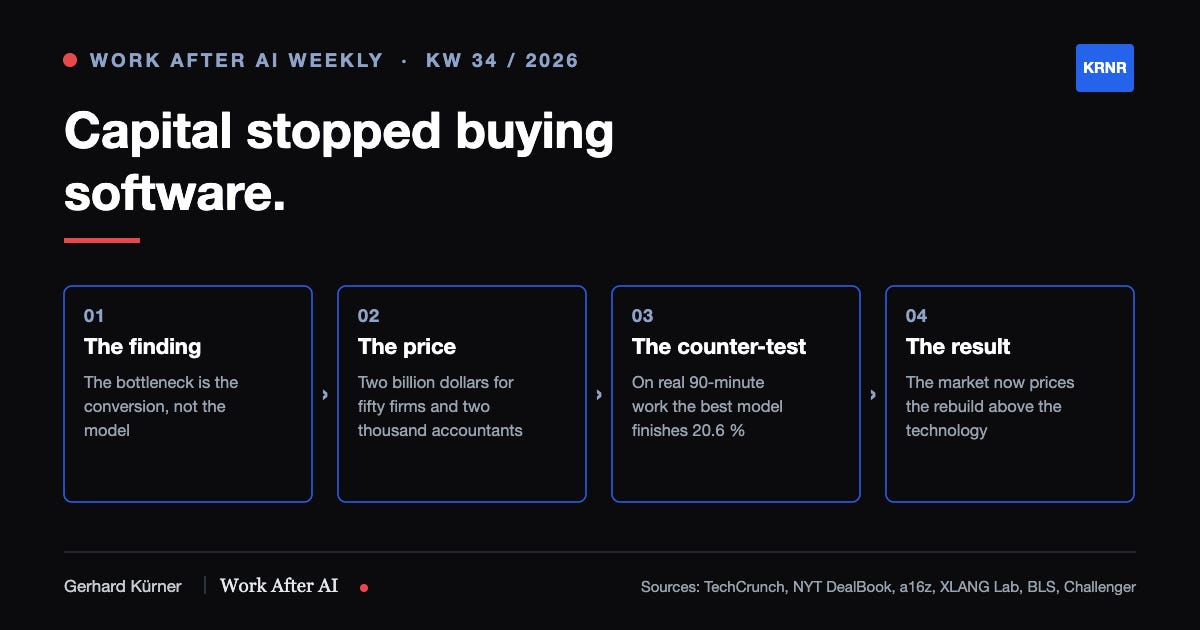
The most instructive number of the week is not a benchmark score. It is a valuation attached to accountants. Thrive Holdings, a spinout of Thrive Capital, raised two billion dollars at a twelve billion dollar valuation on August 12, backed by SoftBank, D1 Capital Partners and Altimeter Capital, and its business is not selling a product. It buys ordinary service companies and rebuilds their operations around artificial intelligence from the inside. Its accounting arm, Current, now holds more than fifty firms with over two thousand professionals. Its IT arm, Shield, holds around twenty companies. More than seventy businesses sit on the platforms in total, and the fresh capital is going into a third one for permitting and regulatory work on data centers, factories, energy, water and transport infrastructure.
The ownership structure is the part worth pausing on. OpenAI took a stake in December 2025 and, as part of that deal, sends its own people into the portfolio companies to speed up adoption. A model vendor is now partly in the business of running the accounting firms that use its model. That is not an isolated arrangement either, because OpenAI and Anthropic both operate deployment vehicles with large private equity houses, The Deployment Company and Ode with Blackstone, whose product is not intelligence but installation. Thrive publishes several performance figures for its tax agents, all of them company statements without disclosed method, and I would not build an argument on any of them. The business model needs no such support. Someone has decided that the bottleneck is worth twelve billion dollars, and the bottleneck is not the machine.
The leaderboard stopped being the story
The second signal of the week is a disagreement about whether the capability question is finished. On August 10, Andreessen Horowitz published a data piece arguing that computer-using agents have arrived: on the OSWorld-Verified benchmark, scores climbed from about forty-two percent in mid 2025 to eighty-five percent by June 2026, above the human reference mark of 72.36 percent, and the firm puts the running cost at six to eight dollars an hour against roughly ten for offshore back-office work and thirty to forty-five in the United States. Those hourly figures come from three of the firm’s own investment partners and from the price lists of a few outsourcing brokers. They are a claim, not a measurement, and the same house published this year’s other widely shared adoption piece, so the interest is worth stating twice.
Six weeks earlier, the laboratory that built the test had already replaced it. XLANG Lab in Hong Kong, working with Snorkel AI, released OSWorld 2.0, which swaps isolated clicks for one hundred and eight complete work processes, each estimated at around one and a half hours of human time. On that version the best model falls from 83.5 percent to 20.6 percent of tasks fully completed, at roughly seventy-two dollars of compute per task. The authors are explicit that the failure is not operating the interface. It is holding instructions across the length of a task, noticing details that appear halfway through, guessing instead of asking, and never checking its own work. Those are not model properties. Those are the things a supervisor teaches a new colleague in the first month. The a16z piece does not mention the newer test.
The digital colleague gets an identity and a budget before it gets a job
The third pattern runs underneath both. Organizations are building the administrative layer for machine workers faster than they are deciding what those workers should do. Anchorage Digital, the first federally chartered digital asset bank in the United States, now gives AI actors controlled access to company money, with a verifiable identity, defined spending limits and a complete audit trail, and it calls the standard Know Your Agent in deliberate echo of the customer checks banks already run. Pantera Capital, an investor in the company, put the case plainly in its portfolio letter on August 13: agents have started to move money, and treasury systems were built for people. The question of who is liable for what a digital colleague does is being answered in the banking connection long before it is answered in a policy document.
Compute is moving the same way, out of the IT department and into procurement. Silicon Data closed the first tranche of a 30.5 million dollar Series A on August 11, led by the Valor Atreides AI Fund with F-Prime Capital among the participants, to build price indices and forward curves for computing power. The investor list is the signal: a commodities exchange, CME Group, a proprietary trading house, DRW, and a chipmaker, Samsung, in the same round. When a resource can be indexed and hedged, it stops being an infrastructure line item and becomes a purchasing and risk decision, which moves it to a different desk in the building.
Signals at the margin
Governance: Anthropic said on August 11 that it will embed machine-readable watermarks in text from new Claude models, worldwide rather than only in Europe, to meet commitments under the European AI Act transparency code that apply to models launched in the EU from August 2. TechCrunch reported a day later that part of the user base is unhappy, because the marking makes visible where the tool was used at work and at university. European rule-making has produced a technical fact that every organization will now have to manage.
Labor: the Bureau of Labor Statistics reported on August 7 that US payrolls fell by 23,000 in July, with May and June revised down by 103,000 between them, while unemployment held at 4.1 percent. Challenger, Gray & Christmas counted 33,429 announced cuts in July, the lowest month in two years, with AI the most frequently named single reason for the fifth month running, alongside 16,095 announced hires, the strongest July since 2022. The firm also documents an attribution fight at the Montefiore hospital group in the Bronx, where twelve utilization review posts went after new software arrived. The union calls it replacement by AI, the hospital calls that misleading, and Challenger has had to open a category called technological update, possibly AI, to file such cases at all.
Defense: Heaviside Industries raised a 60 million dollar Series B on August 12 led by Felicis. The company has sixty employees, twenty of them engineers in Oslo, buys its warhead from Nammo and keeps the autonomy software in house. That division of labour is the strategic question of the coming years in one balance sheet.
The week at a glance
Thrive Holdings: 2B at a 12B valuation (Aug 12), backed by SoftBank, D1 Capital Partners and Altimeter Capital. Buys ordinary service companies and rebuilds their operations from the inside; OpenAI has held a stake since December 2025.
Silicon Data: 30.5M Series A first close (Aug 11), led by the Valor Atreides AI Fund with F-Prime Capital, CME Group, DRW and Samsung participating. Price indices and forward curves for computing power.
Heaviside Industries: 60M Series B (Aug 12), led by Felicis with Hedosophia and Menlo Ventures. Sixty employees, bought hardware, autonomy software kept in house.
Infinimmune: 75M Series A (Aug 11), co-led by Playground Global and Regeneron Ventures. In-house antibody language models compress the expert judgment cycle in drug discovery.
Anchorage Digital: product rather than a round, highlighted in Pantera Capital's portfolio letter (Aug 13). Machine workers get a verifiable identity, spending limits and an audit trail.
What this says about the long rebuild
Put the two ends of the week next to each other. On one side, a benchmark that its own authors had to replace because it no longer distinguished anything, and a newer one on which the best system finishes one task in five as soon as the work runs for an hour and a half. On the other, two billion dollars paid for the right to reorganize accounting firms from the inside. The capability is real and it is arriving quickly. What it cannot do is hold an instruction across a long process, notice the detail that appears in the middle, or ask instead of guess. Those are properties of a working organization, not of a model, and they are exactly what takes years to build.
My annual report, Work After AI, appears this autumn and calls this the long rebuild: the third of the three forces that decide how work actually changes, and the slowest of them. It is the reason the gap between what the technology can do and what organizations get out of it has not closed in three years, and the reason the market has now started to price the closing of that gap higher than the technology itself. When capital would rather buy two thousand accountants than sell them software, it has stopped betting on the model and started betting on the rebuild.
Reading the week
None of this is a scoreboard of who invested how much. The deals matter here only as evidence, and the evidence points one way. The organizations that will get something out of artificial intelligence are the ones that were already good at writing things down, at handing work over cleanly, at saying what a good result looks like, because those are precisely the capabilities the machine is missing. The rest will keep buying licenses and reading leaderboards. Whoever waits will find that it was there all along, and that they did not see it coming.
Gerhard Kürner is CEO of 506.ai, the European platform for Service-as-a-Software and agentic engineering, and author of Work After AI. Around 1,000 conversations with boards, owners, and PE funds across DACH and Europe.