


Work After AI Weekly, by Gerhard Kürner. Every Friday I look at where the most sophisticated capital in the world is placing its bets, not because the investors themselves are the story, but because their bets are one of the clearest early signals we have for where work, organisations and enterprise software are actually heading. This week’s signal comes from the deals of the firms ranked twenty-one to thirty in the 2026 Strebulaev-Jackson Venture Ranking.
Two weeks ago companies started hiring an AI workforce. Last week that workforce got its first management structure, someone to certify it, someone to watch it, someone to keep it affordable. This week answers a harder question. What actually has to happen before a company hands a digital colleague something that matters, a task where a mistake is not an embarrassment but a liability.
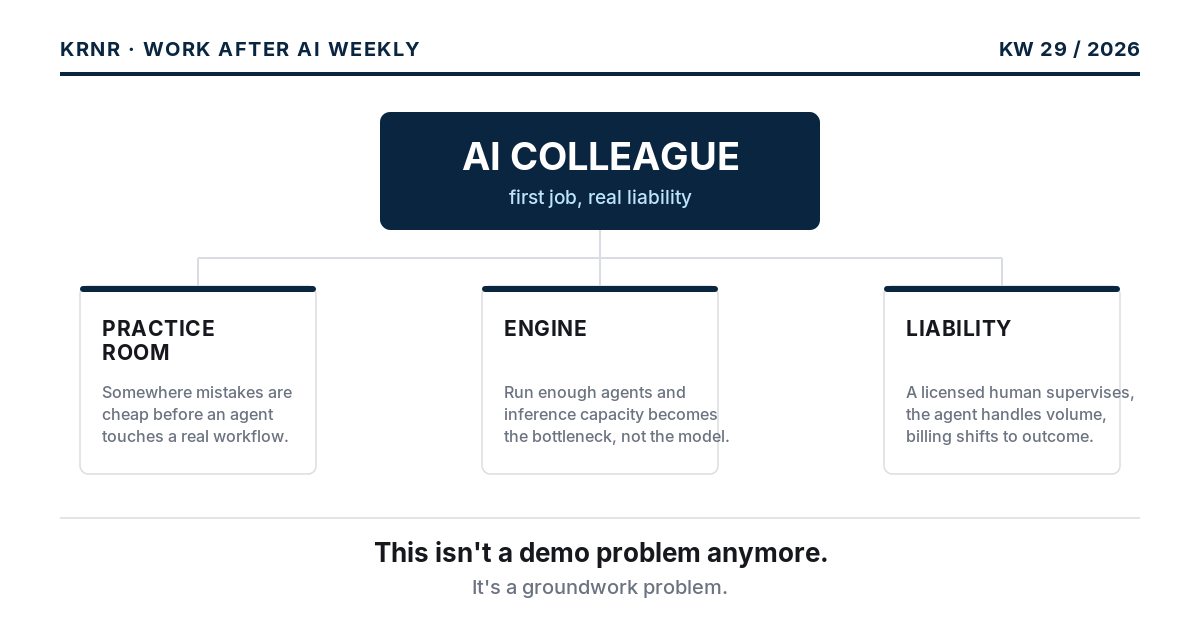
Three deals this week trace that path in order. First a place to practice before anything is real. Then an engine big enough to run the practice at scale. And then, for the first time in this series, proof that the approach holds up in a profession where being wrong has always carried a price.
The practice room before the real job
No employer, human or otherwise, hands a new hire the keys on day one. There is a training period, a supervised stretch where mistakes are cheap and reversible, before anyone is trusted with something that cannot be undone. Companies building autonomous colleagues are discovering they need the same thing, and they are building it deliberately instead of hoping the model figures it out live in production.
You can already see this priced into the market. Wing VC led a 40 million dollar Series A into Bespoke Labs, with Mayfield Fund among the backers, for a company that builds the simulated environments and evaluation benchmarks agents are tested against before anyone lets them near a real workflow. The company is behind Terminal-Bench and OpenThoughts, benchmarks used across the industry to check whether an agent actually does what it claims before it gets production access. The pitch is not a smarter agent. It is a rehearsal space, and the fact that investors are funding the rehearsal space separately from the agent itself tells you how seriously the industry now takes the gap between demo and deployment.
The engine that cannot run out
A practice room only matters if the company can afford to run what graduates from it at scale, across every function, every day. That turns out to be a harder problem than picking the right model. It is a hardware problem, and this week’s biggest check went straight at it.
General Atlantic led the first close of a 1 billion dollar Series F into SambaNova Systems at an 11 billion dollar valuation, alongside Seligman Ventures, T. Rowe Price and Capital Group. SambaNova builds dedicated inference hardware, a direct alternative to renting Nvidia capacity, aimed at the fact that a company running a real digital workforce is not making one API call at a time anymore, it is running continuous inference across dozens of agents doing real work all day. The bet is not on which model wins. It is on the plumbing underneath, the same plumbing that decided last week’s story about whether an autonomous colleague is actually cheaper than the human it replaced.
The first regulated profession says yes
Everything above is preparation. This is the test case that matters, because it is the first deal in this series where the job on the other end carries real professional liability if it goes wrong.
Khosla Ventures led a 120 million dollar Series C into Norm AI at a 1.2 billion dollar valuation, with Coatue, Bain Capital Ventures, Blackstone, Craft Ventures and others participating. Norm AI builds AI agents that draft legal documents and handle compliance work under the supervision of human lawyers at its affiliated firm, Norm Law, which already serves clients with a combined 30 trillion dollars under management. Legal work has long been treated as the profession automation could not touch, because a mistake does not just cost time, it creates liability that lands on a licensed human. What changes here is not that the agent replaces the lawyer’s judgment. It is that the firm’s business model is shifting from billing by the hour to pricing by outcome, which only works if the agent doing the underlying drafting is reliable enough that the human supervisor is checking judgment calls, not fixing basic errors. That same structure, agent does the volume, licensed human owns the liability, outcome-based pricing replaces the billable hour, is the template every other regulated professional service is watching right now, audit and compliance work included.
The deals, at a glance
General Atlantic → SambaNova Systems: 1B (Series F, first close). Inference hardware becomes the enterprise AI bottleneck.
Khosla Ventures (lead), Coatue → Norm AI: 120M (Series C). A regulated profession goes agentic, with liability still human.
Wing VC (lead), Mayfield Fund → Bespoke Labs: 40M (Series A). Practice environments before agents get real authority.
Signals at the edge
Three background trends are worth tracking even though they sit outside the work lens this week. Energy remains the structural constraint behind every deal above. A US heatwave this week strained the power grid supporting data centre growth, hyperscaler AI capital spending is on pace for roughly 750 billion dollars in 2026, and the Department of Energy expects data centres to draw as much as twelve percent of US electricity by 2028, up from four percent today, which means the inference capacity SambaNova and others are building is itself rationed by the grid. Defense tech funding has already passed 14.6 billion dollars in 2026, ahead of the entire prior record year, with Anduril alone raising a 5 billion dollar round at a 30.5 billion dollar valuation, but Fortune reported this week that investors in the category are now openly asking whether defense tech has become its own bubble stacked on top of the wider AI one. And the macro mood has not cooled. An internal US Treasury report is reportedly warning that the AI market shares structural risk with the dotcom bubble, a warning echoed this year by the Bank for International Settlements, even as AI companies keep pulling in a growing share of all venture capital.
What this leaves on the table
Put the three deals together and a clearer picture of what it actually takes to trust a digital colleague with something real starts to form. It has to practice somewhere safe first. It has to run on capacity that will not buckle the moment it scales past a pilot. And even then, in the one profession that put this to a real test this week, a licensed human still owns the outcome, just fewer of the hours that lead to it.
That is a more demanding bar than most companies are currently building toward. Plenty of AI rollouts skip the practice room and go straight to production, skip the capacity planning and hope the vendor’s infrastructure holds, and skip the question of who is actually liable when the agent gets something wrong. The capital in this week’s data is not a scoreboard of who wrote which check. It is an early map of what the companies actually getting this right are building first, the parts that do not show up in a product demo. Whoever keeps skipping that groundwork will find, a few reporting cycles from now, that it was there all along, just built by someone else first.
Gerhard Kürner is CEO of 506.ai, the European platform for Service-as-a-Software and agentic engineering. More than 1,000 conversations over the last three years with boards, owners, and PE funds across DACH and Europe.