


Work After AI Weekly, by Gerhard Kürner. Every Friday I read the week’s signals from two sources, the investments of early-stage investors and the findings of research institutions, the same evidence base my annual report on AI and work is built on. Not because the investors themselves are the story, but because their investments are one of the clearest early signals we have for where work, organisations and enterprise software are actually heading.
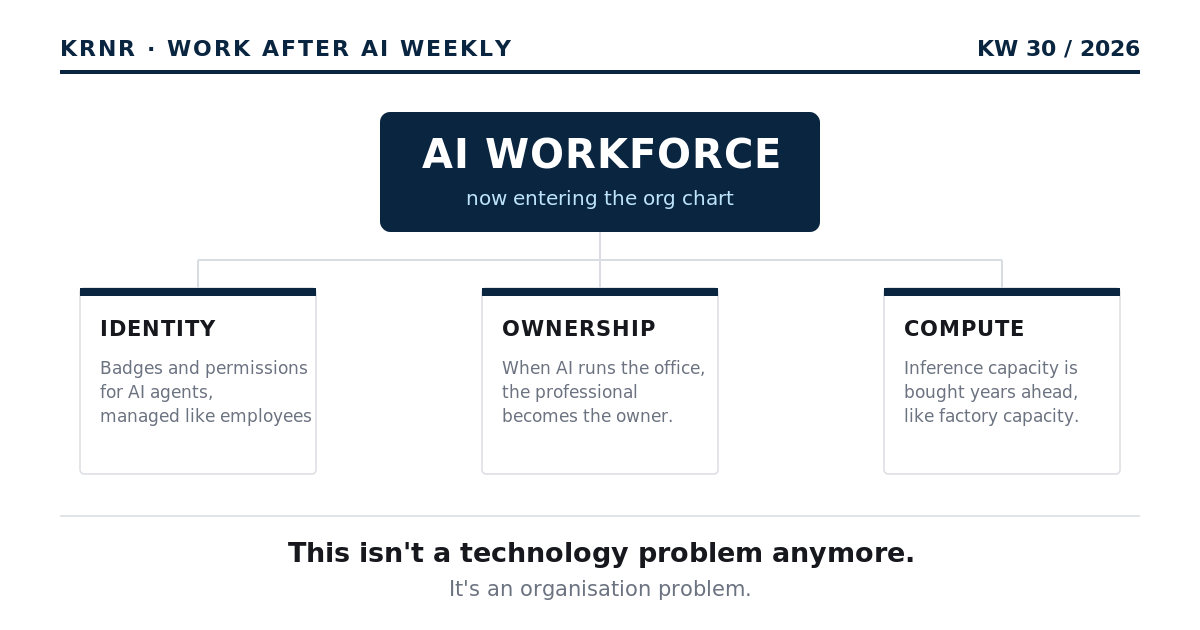
Over the past three weeks this series watched companies hire an AI workforce, build a management structure over it, and hand it its first job with real professional liability. This week the digital colleague stops being a project and starts appearing in the systems that define what an organisation actually is. It gets an identity in the access directory, the same way a human hire does on day one. It starts changing who owns the business, because a professional whose entire back office is run by software no longer needs an employer. And the capacity it runs on is now being bought the way industrial firms buy factory capacity, years ahead and in billions.
The digital colleague now needs a badge, not just a login
Every organisation has a quiet system that decides who is allowed to do what, and until now it only had to answer for people. That assumption is breaking. Once dozens of AI actors work inside a company, each one needs an identity, a scope of permissions, and someone accountable for what it does with them, and managing that sprawl is becoming its own discipline rather than a checkbox in the IT department.
The market is already pricing this in. Oak, a company building what it calls an AI-native identity operating system, one control plane that manages humans, machines and AI agents as equal citizens of the directory, came out of stealth this week with a 60 million dollar seed round co-led by Accel, CRV and Greylock, unusually large for a seed and closed quietly back in late 2025. The banks are living the same shift in plainer language: Reuters reported this week that BNY now treats its digital employees as team members with their own logins and a human manager, and that other large banks are testing agents for core processes. When a bank gives a piece of software a login, a nickname and a supervisor, the identity system has become the org chart.
The professional keeps the license, the AI runs the office
Vertical AI spent the last two years selling efficiency to large employers. The more interesting move this week points the other way. When an AI operating system can run scheduling, billing, referrals and prior authorisations on its own, the licensed professional no longer needs the institution that used to provide all of that around them. The technology stops making employees more productive and starts making them owners.
Corner Health, which builds a network of primary care practices owned by the nurse practitioners who run them, raised 32.5 million dollars across seed and Series A this week, with Oak HC/FT leading the Series A. The company says ninety percent of its clinics operate without additional staff, a figure from its own announcement and worth reading as such, because the administrative work is carried by Cora, its AI-native practice operating system. The same pattern is arriving at institutional scale: Bunkerhill Health raised a 25 million dollar Series B led by Khosla Ventures this week for a platform that lets hospitals build their own AI actors instead of buying finished ones, with twenty-two agents already productive at one Texas health system.
This is the pattern the coming annual report calls the capability question. Work After AI, the yearly review of artificial intelligence and work that I will publish this autumn, argues that the decisive variable is not which model an organisation licenses but whether it builds the capability to make the technology productive inside its own walls. A one-clinic practice in Arizona and the Mayo Clinic are, on this evidence, now working on exactly that same problem.
Compute is bought like factory capacity now
A digital workforce has a means of production, and it is not the model. It is the inference capacity the model runs on, and the companies planning to field that workforce at scale have stopped treating it as a utility bill and started treating it as strategic procurement, contracted years ahead.
Reflection AI, backed by CRV since its seed round, signed a compute agreement worth more than 1 billion dollars with Nebius this week, running to 2029, stacked on top of an earlier capacity deal with SpaceX’s Colossus 2 worth up to 6.3 billion dollars, all to train open-weight frontier models and run its coding agent. Even the capital itself is retooling: Paradigm, long the technical flagship of crypto investing, closed a 1.2 billion dollar fourth fund the week before this window with a mandate that now spans AI and robotics alongside crypto. When specialist capital that committed redraws its own mandate, that says where the next decade of production capacity is being built.
The deals, at a glance
Oak (Accel, CRV, Greylock, 60M seed, out of stealth): AI agents become identities to be managed like employees.
Corner Health (Oak HC/FT, 32.5M seed plus Series A): the AI office turns licensed professionals into owners.
Reflection AI (CRV, 1B+ compute deal with Nebius to 2029): inference capacity becomes strategic procurement.
Bunkerhill Health (Khosla Ventures, 25M Series B): hospitals build their own AI actors in-house.
Chai Discovery (Battery Ventures participating, 400M Series C): vertical AI reaches regulated pharma research.
Paradigm Fund IV (1.2B new fund, week prior): specialist crypto capital retools toward AI and robotics.
Signals at the edge
Who writes the rules for the digital workforce? Within days of each other, two documents mapped the governance gap at the model layer from opposite directions. Google DeepMind chief Demis Hassabis proposed a FINRA-style, largely industry-funded standards body that would test frontier models before release and could coordinate a slowdown, with compliance eventually required for access to the US market regardless of a model’s origin. Days earlier the Future of Life Institute, an advocacy nonprofit with a declared regulatory agenda, published its summer index, in which an independent expert panel concluded that self-governance is no longer credible without external verification. No company scored above C+, the leaders have walked back their earlier pause commitments, and Europe’s flagship Mistral came last even as the EU leads on regulation, though Mistral objects that the scoring logic does not fit its development approach. Read together, the proposal and the report card make the same point: the rules of the field are being written elsewhere, and safety capability, like productive capability, is built inside the organisation rather than conferred by regulation.
Elsewhere, energy remains the binding constraint. The PJM capacity auction, covering the largest US grid, cleared at a record 16.4 billion dollars this week, with data centres accounting for roughly 6.3 billion of it. In defense, Helsing raised a 1.8 billion dollar Series E at an 18 billion dollar valuation, co-led by Lightspeed and General Catalyst, the largest European venture round on record. And on the labour side, Challenger, Gray and Christmas reported that AI remained the most cited reason for US job cuts in June, even as total announced cuts ran well below last year’s pace.
What this leaves on the table
Most of the firms in this week’s scan wrote no verifiable checks in the window, and that quiet is itself information: the money has moved down the stack, into identity, ownership structures and capacity contracts, the parts of the digital workforce that never appear in a product demo. None of this is a scoreboard of who invested how much. It is evidence for a single claim: the organisations taking this seriously are no longer asking what the technology can do. They are asking what has to be true inside their own walls, in their access systems, their ownership models and their procurement, for it to do that work reliably. Whoever waits for that question to answer itself will find, a few reporting cycles from now, that it was answered long ago, inside someone else’s walls.
Gerhard Kürner is CEO of 506.ai, the European platform for Service-as-a-Software and agentic engineering. More than 1,000 conversations over the last three years with boards, owners, and PE funds across DACH and Europe.