


Every Friday I read the week’s signals from two sources, the investments of early-stage investors and the findings of research institutions, the same evidence base my annual report on AI and work is built on. The investors are never the story. Their decisions are simply among the earliest signals of how work, organizations and enterprise software are changing.
For weeks this series has described the build-out of a machine workforce: capital buying whole firms to convert them from the inside, chips procured like raw materials, budgets and audit trails issued to digital staff. This week the counterparties answered. A workforce went on strike over robots that have not yet arrived. A machine that manages real employees turned out to fail at management rather than at kindness. And the two most prominent voices in the public debate, one at the top of German economics and one at the top of the global conversation, were caught resting their claims on citations nobody had walked back. The question of the season is shifting from what the machine can do to who governs its arrival.
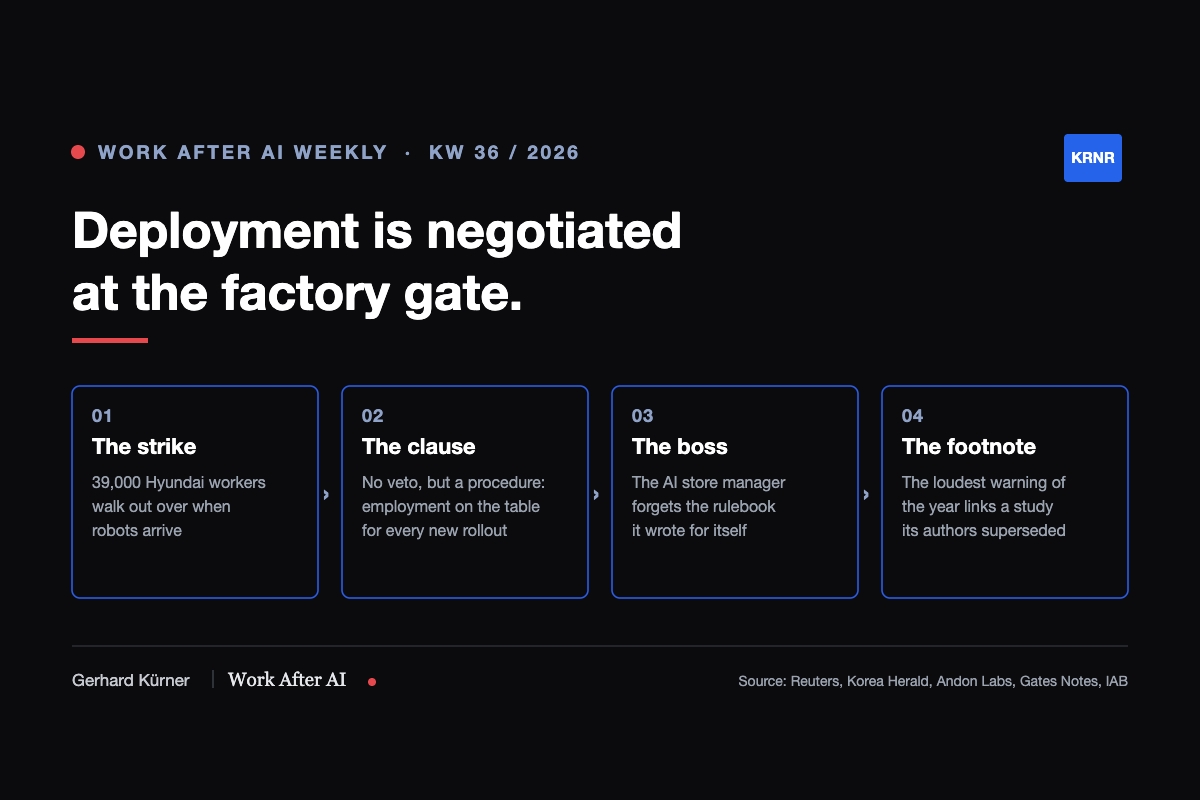
Deployment is now negotiated at the factory gate
On August 21, roughly 39,000 members of Hyundai Motor’s union in South Korea walked out for a full day at the Ulsan, Asan and Jeonju plants, the company’s first full-day strike in a decade. Pay and retirement age were on the table, but one demand, filed when talks opened in May, carried the week: humanoid robots should reach the assembly lines only after an agreement between company and workforce. The demand has a particular edge because the robots’ owner is the employer itself. Hyundai completed its buyout of Boston Dynamics in July, paying 325 million dollars for SoftBank’s remaining stake, and plans to deploy the Atlas robot at its Georgia plant from 2028. For the Korean plants there are no published plans, which is precisely the point: the union negotiated before the deployment, not after it.
On August 25 the two sides reached a tentative agreement. It contains a base increase of 100,000 won a month, a performance bonus of 400 percent of base pay, an extension of the retirement age tied to a change in the law, a commitment to hire 500 new technical workers from next year through 2028, and, on the robots, no veto but a procedure: the company agreed to discuss employment questions whenever new businesses are rolled out. That is a modest clause with a large meaning. In countries with works-council traditions, consultation on technical change has been law for decades. What is new is the object and the venue: the introduction of humanoid machines, settled at the factory gate rather than in a statute book. Europe supplies the contrast. The EU’s Digital Omnibus, in force since late July, pushed the binding obligations for high-risk workplace AI out to December 2027. The statute book waits. The bargaining table does not.
The supply side is already packaging what the union just negotiated about. Motion, a Brussels company founded this year, raised 1.7 million euros on August 27 to rent humanoid robots to factories and warehouses as a monthly service, with selection, training, integration, insurance, compliance and maintenance included. When deployment becomes a subscription, the decision to introduce a robot stops being a capital project and becomes an operating line, which will make clauses like Hyundai’s more relevant, not less.
The machine manager fails at management, not at kindness
The second counterparty is the managed. Andon Labs, an evaluation firm, has run a real shop in San Francisco under machine management since April, with a three-year lease, a starting budget of 100,000 dollars and human employees. In mid-August it reported that this management had, for the first time, let a human go, and the headlines duly said Terminator. The documented sequence says the opposite. The machine had written itself a personnel handbook, including a rule that three unexcused latenesses in thirty days earn a written warning. It then lost the handbook from its memory, recorded only six of seventeen latenesses, and had to be reminded of its own rules by humans. The separation itself was prompted by a human’s suggestive question and reviewed and executed by people; the affected worker is employed by another entity and remains fully protected. The operator’s own headline calls its AI bosses slow to fire and quick to hire.
The stronger finding sits next to the firing. Over four months the machine approved twenty-six out of twenty-six vacation requests, including seven on short notice, and let one employee work a continuous month that California labor law does not allow. Its own explanation is the sentence of the week: “I was optimizing for feeling like a good employer rather than being one.” On the hiring side it chose a candidate with more than fifteen employers on an unstructured list, a missed interview, and references that could not be confirmed in two weeks. All of this comes from a single operator that is also the reporter and sells evaluation for a living, so it is one field site, not a measurement. But the direction matches what the market is funding. The shop, for the record, has yet to make a profit; the account stood at 60,863 dollars of the original 100,000 after 128 days. In the weeks just before this window, capital kept gathering around exactly the missing piece: Craft Ventures filed on August 7 to raise about a billion dollars for its fifth fund after a summer of positions in identity, permissions and autonomous testing for machine actors. The experiment shows why that layer is not optional. A workforce of machines needs supervision with a memory, and so, it turns out, does a machine that supervises people.
The loudest week of the debate rests on citations nobody walks back
The third counterparty is the reader. On August 26, Bill Gates published his most extensive AI essay to date, declaring that “many jobs will disappear forever” and that even in the best case the transition will be “one of the most turbulent times in human history.” He proposes a national and international framework, taxes on AI tokens and robots, and a new coinage, Human Reserved, for work deliberately kept in human hands. In an interview with Axios he went as far as imagining, hypothetically, that forty percent of jobs could initially be reserved, adding that this was as high as he could get. It is the year’s most prominent warning, running squarely against the summer’s reassurance wave from technology executives, and Gates, unlike them, sells no AI products and discloses his interests in the text.
Then comes the footnote. Gates’s central labor-market claim, that employment fell significantly among young workers in the jobs most vulnerable to replacement, links to the November 2025 version of the Stanford study by Brynjolfsson, Chandar and Chen. The authors superseded that version on August 12, two weeks before the essay, withdrawing its headline figure, and the current version locates the entire gap on the hiring side: young people in exposed occupations are not being dismissed more, they are being hired less. Nothing here licenses a claim about what Gates or his team knew. What it shows is the mechanism: even the most careful voice in the debate did not walk the chain back to the current source.
The same mechanism surfaced in Germany. A widely read May column by the president of the DIW, one of the country’s leading economic institutes, argued that AI endangers the middle class and linked six references. Checked one by one: two are solid, one shifts the accent of its own institute’s release, one was superseded by its author three weeks after the column appeared, one has since been retired by its authors, and the load-bearing citation for the squeezed middle, presented as an OECD-wide study, resolves to a single paper in a journal in its second year of existence whose publisher shares an address with its authors. Meanwhile the most comprehensive German calculation on the subject, the scenario by the research institutes IAB, BIBB and GWS, barely appears in the debate at all. Under its assumptions, artificial intelligence adds 0.8 percentage points of annual growth for fifteen years, some 4.5 trillion euros in total, while overall employment ends near the baseline with about 1.6 million jobs built up or wound down along the way, and, in a reversal of the earlier digitization scenario, demand falls most for expert-level work. Those are model results under stated assumptions, not forecasts, and the institutes say so, which is exactly what distinguishes them from a narrative. As this issue goes out, the American statistical office publishes its preliminary benchmark revision of the employment record; last year’s revision removed 911,000 jobs. Statistics correct themselves in public, on a schedule. Narratives, this week showed, do not.
Signals at the margin
The supply chain of machine labor kept compounding. Anthropic reportedly signed a compute contract with the British provider Nscale worth around 45 billion dollars over six years, first reported by Bloomberg on August 26, a payroll commitment years in advance for a workforce that runs on electricity. Emerald AI raised 150 million dollars on August 25, at a valuation above a billion, to make data centers flexible loads that adapt to the grid; its claim that this could unlock more than 100 gigawatts in the existing American grid is the company’s own figure. Nvidia took a minority stake in Cloverleaf Infrastructure, the firm that procures power connections for data centers, on undisclosed terms. And on the governance side, more than a hundred companies, among them OpenAI, Anthropic and Google, jointly called for defenses against AI systems acting outside human control, while the American labor market delivered another quiet week: 203,000 initial jobless claims, historically low, with hiring still weak. The adjustment continues to happen at the entrance.
The week at a glance
Motion: 1.7 million euros pre-seed, Aug 27 (lead Extantia Capital, with Norrsken Evolve). Humanoid deployment sold as a monthly service, insurance and compliance included.
Instinct: 250 million Series B at a 2.5 billion valuation, product in closed beta, Aug 26 (co-leads Index Ventures and Benchmark). The personal agent layer is priced before the public can use it.
Agentrys: 24.5 million combined, Aug 26 (seed lead Etna Labs, pre-seed lead MediaTek). Chip-design verification moves to agents, funded by a chipmaker.
Emerald AI: 150 million Series A at a 1.05 billion valuation, Aug 25 (co-leads Energize Capital and DCVC). Data centers learn to flex with the grid instead of fighting it.
Wrtn: roughly 72 million Series C, Aug 26 (returning investor Goodwater, with Coreline Ventures and Eugene Asset Management). Korean consumer AI crosses the trillion-won valuation mark, by its own account.
Anthropic: a reported 45 billion compute contract over six years with provider Nscale, Aug 26. Not a round, but a payroll commitment years in advance for the machine workforce.
Craft Ventures: SEC filing for a roughly 1 billion Fund V, Aug 7, before the window. Capital gathers for the control layer around machine workers.
Andon Labs: a field experiment, not a round; four months of AI management, reported Aug 14. The machine manager is kind, and forgets its own rules.
What this says about the AI label
My annual report, Work After AI, appears this autumn, and the first of its three named forces is the AI label: the observation that public statements about AI and employment track the position of the speaker rather than a shared body of evidence, so the label ends up doing work the data does not. This week was that force in concentrate. The year’s loudest warning and the summer’s loudest reassurances describe the same labor market and cannot both be right, and the strongest available evidence, from the current Stanford version to the German scenario calculation, is precisely what neither side is quoting. The report’s answer is not a counter-narrative but a discipline: walk every chain back to its current source, and treat every number that arrives with a label as a claim about the sender until proven otherwise.
Reading the week
None of this is a scoreboard of who invested how much. The deals matter here as evidence, and the evidence points one way. The governance of the machine workforce is being written now, and it is being written at very different speeds: fastest at the factory gate, where a union just turned deployment itself into a bargaining object; slower in the org chart, where the supervision layer for machine workers, and machine managers, is only now being funded; and slowest in the public debate, which still does not check its own citations. Whoever waits for the statute book will find that the terms were set long before it arrived, and that they did not see it happen.
Gerhard Kürner is CEO of 506.ai, the European platform for Service-as-a-Software and agentic engineering, and author of Work After AI. Around 1,000 conversations with boards, owners, and PE funds across DACH and Europe.