


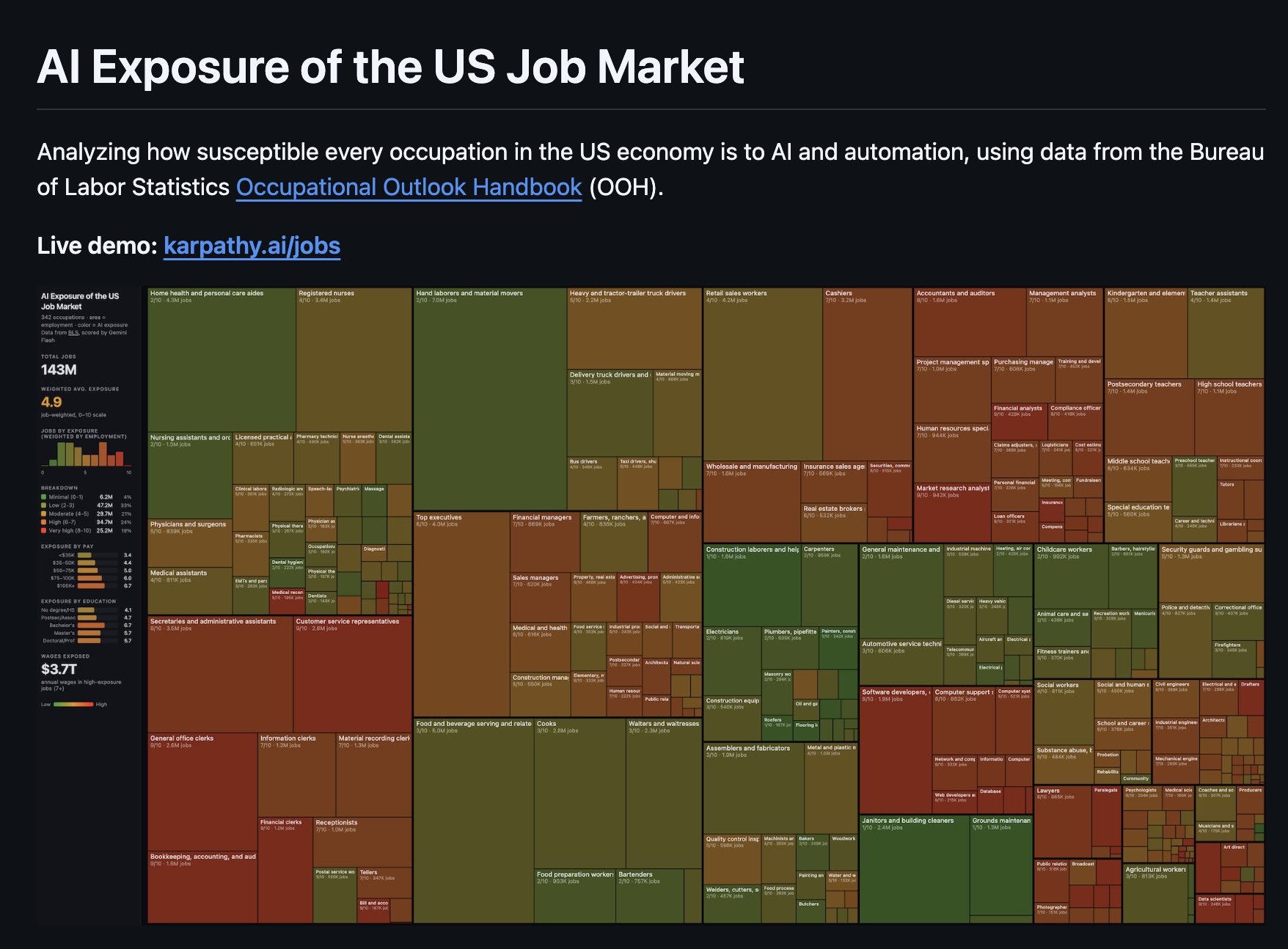
This morning, Andrej Karpathy published the most precise AI jobs analysis anyone has produced.
By tonight, it was gone.
Here is what happened. And why the deletion tells us more than the data ever could.
The Analysis
Karpathy scored every US occupation on AI exposure. 342 jobs. Each rated 0 to 10 based on how easily large language models could take over the work. The data came from the Bureau of Labor Statistics. The scoring was done by AI, which adds a certain irony to the exercise.
The results were not surprising if you have been watching this space. They were, however, stark when laid out all at once.
42% of all US jobs scored 7 or higher. That is 59.9 million people. $3.7 trillion in annual wages sitting in direct exposure range.
Software developers landed at 8 to 9. Financial analysts, accountants, management consultants, legal assistants: similar. Medical transcriptionists scored a perfect 10. Pure digital input, pure digital output, zero physical component. AI does not need to be better than a human transcriptionist. It just needs to be cheaper and faster. It already is.
The safe jobs? Roofers. Plumbers. Electricians. Nurses. Construction workers. Jobs that require a body in a specific place doing something that cannot be done from behind a screen. These scored 0 to 3.
The weighted average across all 143 million US jobs: 4.9 out of 10.
The entire economy. Halfway exposed.
Then Elon Musk Replied
The tweet spread quickly. It was exactly the kind of data that travels fast: specific, visual, and threatening to enough people that sharing it feels like a warning or a provocation depending on who you are.
Elon Musk saw it and responded publicly: “All jobs will be optional.”
At that point, a technical research project became a political statement. A data visualization became a manifesto. Karpathy’s careful scoring rubric got attached to a worldview he almost certainly did not intend.
Within hours, the GitHub repository was gone. The original tweet deleted.
What the Deletion Actually Means
I want to be careful here. I do not know Karpathy’s reasons. He has not explained them publicly.
But the sequence is telling.
One of the most credible voices in AI research built something honest and methodical. It got picked up by the loudest amplifier in the conversation. And he pulled it back.
That is not a story about data. That is a story about readiness.
We are not ready for this conversation. Not politically. Not socially. Not inside most boardrooms or government offices.
The question of what AI will do to jobs has been theorized, debated, and worried over for years. But when someone actually scores the jobs, one by one, and publishes it as an interactive treemap you can explore with your own name in mind, something shifts. It stops being abstract.
And that is uncomfortable.
The European Context
Here is what I keep coming back to.
In Austria and across Europe, we face a structural labor shortage that is not going away. Demographics are working against us. There are not enough people to fill the roles that need filling, and that gap will widen over the next decade regardless of what AI does.
So the framing of “AI will replace jobs” is, at least in our context, incomplete.
The more useful question is: what happens when AI can do the work that nobody is available to do?
That is not a threat. That is an answer.
Digital team members that onboard like employees, work within defined boundaries, operate under GDPR-compliant infrastructure, and scale without the friction of hiring. Not tools you buy and configure. Colleagues you bring in.
The labor shortage and the AI capability curve are on a collision course. The organizations that recognize this now and build accordingly will not be the ones who were least afraid. They will be the ones who asked the right question earliest.
The Territory Is Still There
Karpathy drew the map. Then rolled it up.
The territory does not care.
The 59.9 million jobs in the exposure range are still there. The accountants and analysts and consultants whose output is text and spreadsheets are still there. The European companies struggling to find qualified candidates for knowledge work roles are still there.
The conversation Karpathy started and then deleted will happen anyway. In boardrooms. In policy discussions. In hiring decisions made or not made.
The only question is whether you are in the room when it does.
---
Gerhard Kurner is CEO of 506.ai and Co-Founder of Kollega, a platform for AI-powered digital team members built for European enterprises and public sector organizations.