


Every Friday I read the week’s signals from two sources, the investments of early-stage investors and the findings of research institutions, the same evidence base my annual report on AI and work is built on. The investors are never the story. Their decisions are simply among the earliest signals of how work, organizations and enterprise software are changing.
If a company gives everyone the same AI license and gets back very different results, whose problem is that, the model’s or the people’s? This week brought the first clean measurement of that question, and it reorders a debate that has been conducted almost entirely in terms of models, leaderboards and capability jumps. The same pattern ran through everything else worth reading this week: the scarce resource in the AI economy is quietly shifting from the technology itself to the way an organization works with it.
Two thirds of the difference sits in the question, not in the model
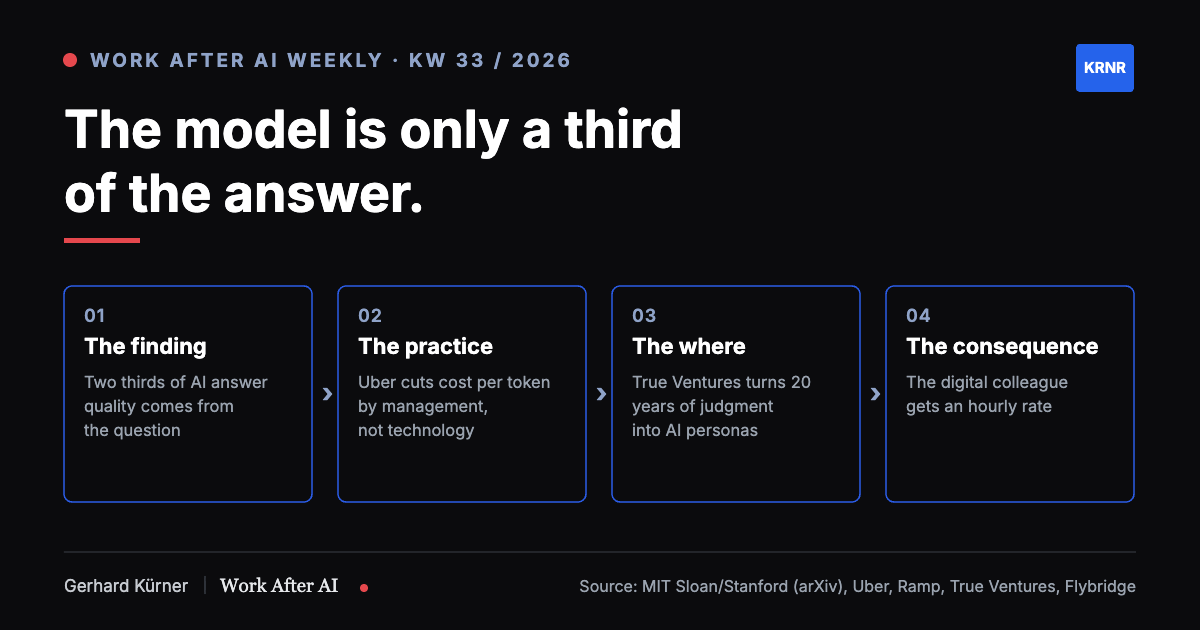
A research group from MIT and Stanford, Taha Choukhmane, Tim de Silva, Weidong Lin and Matthew Akuzawa, has for the first time experimentally separated how much of the quality of an AI answer depends on the model and how much on the person asking. The field is private financial advice, the finding is broader. One thousand American adults wrote their own questions to an imagined AI financial adviser, and those real questions drove a life-cycle simulation running on GPT-5.2. Because gender labels were randomly inserted into questions that did not mention gender, the design can attribute differences cleanly: for the recommended equity share, two thirds of the variation comes from how people ask, one third from how the model answers the same question. The authors conclude that the demand side will keep limiting what people get out of these systems even as the models improve.
The paper carries a second number that belongs in every reliability discussion. The same prompt, asked five times, produced a mean spread of 6.5 percentage points in the recommended equity share, and repeating only the researchers’ evaluation step reduced that to 1.6 points. The noise sits in the machine, not in the measurement. All of this is a working paper without peer review, built on an American sample and one-shot prompts, and every wealth effect in it assumes that people actually follow the advice. But the core decomposition converges with an earlier experiment by Colaiacovo and Koning, in which founders’ willingness to delegate work to AI was explained only about a third by their beliefs about the technology. Two different questions, two different methods, the same third: most of what decides the outcome is human.
Uber gives the digital workforce an hourly rate
In May, Uber was the cautionary tale of enterprise AI spending. The company’s annual AI budget was consumed within four months, and its operations chief said openly that the link between the spending and shipped features could not be established. On August 5, Uber’s CFO reported falling cost per token at rising usage and broadly stable total spend, and CTO Praveen Neppalli Naga declared on X the end of the tokenmaxxing epoch. Between the two statements lies no new technology, only different management: better caching of recurring requests, changed defaults for model choice and context length, ongoing evaluation of open models per use case, and, most tellingly, a real-time display that shows every developer their own AI cost per hour. A company that shows its people the machine’s cost per hour has given the digital colleague an hourly rate. Uber discloses no amounts, and the doubling of code output per developer that its CFO offered as the benefit measures output, not value, and should be read as an attributed claim rather than a productivity result.
The purchasing side of the same maturation shows up in payment data. The Ramp Economics Lab, whose figures describe American, mostly young and technology-heavy companies on its own platform and are a vendor’s series, reports that 5.8 percent of AI-spending companies used model-serving platforms as access to open and Chinese models in June, up from 4.5 percent in January. These are not the frugal. They spend a median of 248 dollars per employee on AI against 10.59 dollars for the typical AI-spending company, and 96.4 percent of them buy from OpenAI or Anthropic at the same time. The model is becoming a procurement decision inside a portfolio, quality weighed against operating cost, task by task. That is not loyalty to a provider. It is operations management arriving in the AI stack.
The investor turns twenty years of judgment into a working product
On July 31, True Ventures released AI personas of its own partners, trained on twenty years of the firm’s investment notes, memos and meeting archives. Founders can get pitch feedback, product or hiring advice from the personas free of charge, several partners at once if they want, and sessions average more than twenty minutes. The production story matters as much as the product: partner Mike Montano, formerly head of engineering at Twitter, built the system in a single afternoon on Polsia, a True portfolio company. What used to be the scarcest asset of a venture firm, access to partner judgment, has been unbundled from the partners’ calendars.
A day earlier, and just before this issue’s window, Flybridge partner Jeff Bussgang published an essay called The 10x Organization, arguing that AI has created 10x founders who still run 1x organizations, that models are interchangeable while accumulated context compounds, and that documentation, canonical sources and decision logs are turning from bureaucratic burden into strategic capital, because digital teammates cannot work without them. He points to Block and Coinbase as companies rebuilding themselves around that idea, and says Flybridge now screens investments for exactly these organizational learning loops. Two investors, in the same week, acted out what the researchers measured: the value sits in the institution’s accumulated knowledge and in the questions its people can ask, not in the model that everyone can rent.
Signals at the margin
Energy: Base Power raised one billion dollars in a Series D announced on August 3, at a reported thirteen billion valuation, with Addition, Ribbit Capital, Valor Equity Partners and JPMorganChase among the leads, to build home batteries manufactured in the United States. Distributed storage is becoming part of the answer to a grid strained by data centers. Forbes noted on August 6 that most AI power announcements come with a gigawatt figure and few with a firm grid commitment.
Defense: Antares raised 470 million dollars in a Series C on July 27, before this issue’s window, co-led by Paradigm and Caffeinated Capital, to build factory-made nuclear microreactors, with first deliveries to US military bases planned from 2028. The buildout of machine labor is pulling its own power plants behind it.
Labor: Challenger, Gray & Christmas counted 33,429 announced US job cuts in July, the lowest monthly figure in two years, while AI remained the most frequently cited single reason for the fifth month in a row, at 10,970 cuts. Both facts are true at once, and holding them together is the discipline this debate mostly lacks.
Media: On August 2, the Swiss daily Tages-Anzeiger ranked 391 occupations under the headline question of how automatable your job is, based on the DAIOE exposure index. The index authors state in their own FAQ that it measures the potential applicability of AI to occupational content, not automation or job loss, and their firm-level evidence across Denmark, Portugal and Sweden shows, in the authors’ summary, no systematic change in headcount over two decades but consistent up-skilling. The article text concedes exactly this. The headline does not.
The week at a glance
Base Power: 1B Series D at a reported 13B valuation (Aug 3), led by Addition, Ribbit Capital, Valor Equity Partners and JPMorganChase. US-made home batteries for a grid strained by AI data centers.
Antares: 470M Series C (July 27, before the window), co-led by Paradigm and Caffeinated Capital. Factory-built nuclear microreactors, first for US military bases.
True Ventures AI Office Hours: a firm initiative rather than a round (launched July 31). Twenty years of partner judgment, unbundled into AI personas.
The scarce resource was never the model
Read the week’s signals side by side and they describe one economy. A first clean experiment shows that most of the quality of machine work is decided on the human side, in the question. Uber shows that the cost of machine work becomes manageable the moment it is managed, with an hourly rate on the screen. And two venture firms demonstrate where durable advantage accumulates: in the institution’s own recorded knowledge, which the models can amplify but cannot replace. None of this rewards the organization that buys the best license. All of it rewards the organization that builds the ability to work with what it bought.
That ability is the central argument of Work After AI, my annual report on artificial intelligence and work, which appears this fall. It makes the case that the future of work is decided not by what the machine can do but by the capability of the individual company to make it productive on its own knowledge, its own processes and its own questions. This week, the evidence for that case came from a laboratory, an earnings call and two investors’ blogs at the same time.
As always, the rounds and announcements here are not a scoreboard of who deployed the most capital. They are evidence for a thesis, and this week’s thesis is uncomfortable for every AI strategy that ends at procurement: the model is only a third of the answer. The other two thirds are already on your payroll, and whoever waits for a better model to solve that will find that the advantage went to those who worked on the questions, and that they did not see it coming.
Gerhard Kürner is CEO of 506.ai, the European platform for Service-as-a-Software and agentic engineering, and author of Work After AI. Around 1,000 conversations with boards, owners, and PE funds across DACH and Europe.