


There is a quiet moment before every market repricing where the data still looks calm and the people inside the companies already know it is not. We are in one of those moments with AI and work, and the calm is being badly misread.
Torsten Slok, chief economist at Apollo, published a chart that captures the calm perfectly. Weekly employment data across the United States, plotted cleanly, showing zero evidence of AI-driven job losses. His reading is almost cheerful: firms are hiring AI implementation experts, the data center buildout is lifting wages, the whole thing is Jevons paradox in real time, cheaper technology creating more demand and more work. At the same time, individual companies have announced tens of thousands of layoffs this year and named artificial intelligence as the reason. More than 142,000 tech workers gone in five months.
Both pictures are accurate. That is the part almost everyone gets wrong. The flat national line and the brutal company headlines are describing the same economy from two different distances, and the gap between them is not a contradiction to be resolved. It is the most expensive thing in business right now, and it is worth understanding exactly why.
Two numbers measuring two different worlds
Slok is looking at the net balance. Every job in the country, added up, week over week. At that altitude the AI signal dissolves into the churn of an economy that creates and destroys millions of positions a month. Through April, employers announced roughly 300,000 cuts in total, down about half from the year before. Healthcare hires, construction hires, transportation hires. The line stays flat because somewhere a job vanishes and somewhere else one appears.
The layoff headlines measure the opposite thing. Gross announcements from individual firms. AI was named as the reason for around 21,000 cuts in April alone, roughly a quarter of that month’s total, the top stated reason for the second month running. That number is real. It is also nearly invisible at the national level, because it sits almost entirely inside one sector.
So nobody in this debate is lying. The economist with the flat line is right about the balance. The journalist with the layoff count is right about the disruption. The flat line simply cannot see who is losing and who is gaining, and that composition is the whole story.
How much of this is even AI
Here the ground softens for the doom side, and it is worth saying plainly. A large share of these AI-attributed layoffs are not actually caused by AI.
Oxford Economics concluded in January that firms are not replacing workers with AI on any meaningful scale, and that some companies are using artificial intelligence as cover for ordinary cost-cutting. Sam Altman, who has every reason to talk up what the technology can do, admitted there is real AI-washing, where companies blame AI for layoffs they would have made anyway, alongside the genuine displacement. Peter Cappelli at Wharton put it most bluntly. Companies announce cuts on the logic that AI will cover the work. They have not done it. They are hoping.
A finance chief who wants to trim payroll in a soft quarter now has the most fashionable justification in a decade. The label does work the technology has not yet done. Even Andy Challenger, whose firm produces the layoff data everyone quotes, is careful: regardless of whether individual jobs are being replaced by AI, the money for those roles is being moved toward it.
The bet hiding inside the layoff
If companies are cutting heads and pouring capital into AI, the productivity gains should be visible by now. They are not, at least not yet, and this is where the analysis gets interesting, because the absence is not random but structural.
Around 80 percent of companies deploying AI have reported workforce reductions. According to Gartner, those cuts have not translated into stronger returns on investment. The chief AI officer at Cognizant, again a person with no reason to undersell the technology, said he does not know whether the cuts connect to real productivity gains, and that it will take another six months to a year before companies see them.
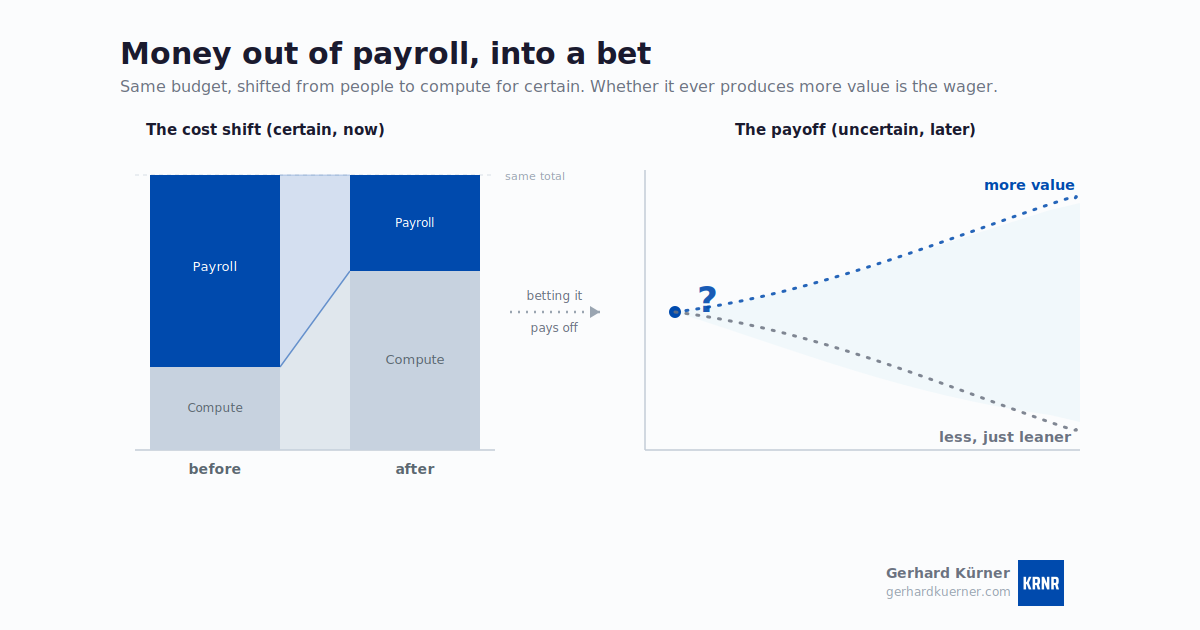
Read the order carefully, because the order is the whole thing. Firms cut the people now. The productivity is supposed to arrive later. The cut is not a response to a realized gain, it is a position taken against a future one. And the most recent reporting tells you what the position actually is: the companies executing the deepest cuts in 2026 are simultaneously posting their strongest-ever results and raising capital expenditure to levels that, in their own words to investors, make human payroll look small. The budget freed by the layoffs flows straight into compute. Cloud contracts, hardware, data centers. Money out of people, money into infrastructure, on the wager that the infrastructure eventually pays back more than the payroll did.
This is the part the headline number cannot show you, and it is the part that matters if you are reading these companies as assets rather than as employers. A firm that has cut its headcount and booked the saving has not become more valuable. It has converted a certain cost into an uncertain bet and recorded the result as efficiency. Those are not the same act, and the accounts do not distinguish them. The saving is real and lands this quarter. The productivity that is supposed to justify it is a promise with a maturity date nobody will name. So the leaner company and the stronger company look identical on the page right now, and they are not the same company. One has cut into genuine slack. The other has cut into its own capacity and is praying the technology backfills it before anyone notices the gap. From the outside, this cycle, you cannot yet tell them apart from the margin line alone. That is the single most useful thing to understand about the present moment, and almost no price reflects it.
The reason the gap is this hard to see from a spreadsheet is that it lives one level below the numbers, in the actual work. After years of building AI systems and watching where they genuinely take load off a team and where they quietly do not, the tell becomes legible: the firms booking a saving have mostly automated the visible, nameable tasks, and left untouched the tacit judgment that was the real reason the role existed. That residue does not appear in a headcount line. It appears eighteen months later, as the thing the AI was supposed to cover and did not.
Watch the split, not the announcements
The clearest signal is not in what any one company says. It is in the fact that the most deliberate players are doing opposite things, and the divergence is information.
IBM tripled its entry-level hiring in 2026, on the reasoning that AI handles many junior tasks but still needs a human in the loop. Other firms are cutting exactly that layer as fast as they can. Look closely at what separates the two bets, because it is not optimism versus caution. It is a reading of where the durable value sits. AI replaces routine, not experience. The junior doing routine work is not only a cost, the junior is the mechanism by which a company manufactures its future seniors. Cut that layer and this year’s margin improves while the supply of the one thing AI cannot yet produce, judgment built from years of doing the work, quietly stops being made. The company that cut looks more efficient now and has mortgaged a capability that does not show up as a liability anywhere. The company that kept hiring looks heavier now and owns an asset its competitors are busy destroying.
Neither bet is provably right yet, and that is the point. When the most sophisticated capital in a sector splits this cleanly on the same facts, it means the repricing has not happened. The market is still treating the cutters’ leaner numbers as straightforwardly good. It has not yet started asking the harder question of what was cut, slack or capacity, bet or saving. When it does start asking, and it will, the gap between those two groups is where value moves. Anyone who can read which is which before the question gets asked is reading three years ahead of the print.
The calm is the opening
None of this is fate, and that is the part both the panic and the complacency miss. The flat line is not destiny, it is a snapshot taken before the interesting part. What it cannot see, composition, the missing productivity, the mortgaged pipeline, is exactly what separates the companies that will be worth more from the ones that will be bought. That separation is not yet in any price, which means seeing it clearly is still cheap and acting on it still counts as foresight rather than catch-up. The quiet moment is not a time to wait. It is the short window where clarity is still an advantage instead of a postmortem.
The chart says nothing happened. Read it properly and it says everything is about to. Whoever waits for the headline number to move will find, in a few years, that the repricing was already underway while the line looked flat, and that they never saw it coming.
Gerhard Kürner is an AI Value Creator and CEO of 506.ai, the European platform for Service-as-a-Software and agentic engineering. Not a theorist, but the analyst who sees more, from years of shipping AI and tech projects paired with an ongoing eye on the research.