


Work After AI Weekly, by Gerhard Kürner. Every Friday I look at where the most sophisticated capital in the world is placing its bets, not because the investors themselves are the story, but because their bets are one of the clearest early signals we have for where work, organisations and enterprise software are actually heading. This week’s signal comes from the deals of the firms ranked eleven to twenty in the 2026 Strebulaev-Jackson Venture Ranking.
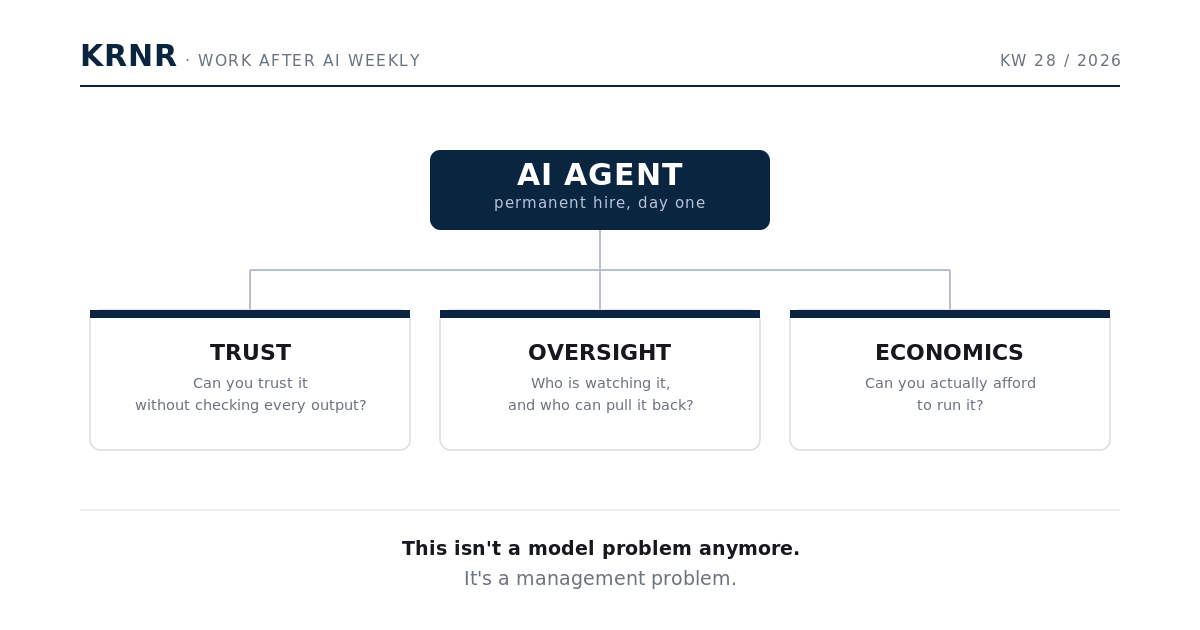
Here is where it starts. Companies have already begun hiring an AI workforce, software that finishes a task end to end instead of assisting a human through it. What this week’s signal shows is what happens next, and it has nothing to do with which firm wrote which check. It is a story about what happens inside a company the moment an autonomous colleague becomes a permanent hire. Three questions show up immediately. Can you trust it. Who is watching it. And can you actually afford to run it.
Read together, the deals of the week are not really about new digital colleagues. They are about the layer that makes the colleagues a company already hired trustworthy, supervised, and cheap enough to keep.
From can it do the job to can you trust it
For two years the competition among AI systems has been about capability, what a model can do that the last one could not. That race is quietly ending. Once an AI system runs as a colleague instead of a chat window, capability stops being the thing that decides who wins. Nobody hires a brilliant colleague they cannot trust in front of a client, and a model that occasionally makes something up is not a colleague, it is a liability with a nice interface. Reliability is becoming the actual product.
You can already see this priced into the market. Khosla Ventures backed Scaled Cognition’s new enterprise AI model, purpose-built to avoid hallucination and stay policy compliant while running live customer service work, with a 100 million dollar Series A. The company does not pitch a smarter model. It pitches a model a business can put in front of a customer without a human checking every output first, and that is a different sale entirely.
The digital teammate gets its own supervisor
Once a company runs autonomous colleagues across more than one function, a second problem shows up fast. Somebody has to see what they are doing, which systems they touch, and be able to stop them when something goes wrong. That supervisory function is turning into its own category of enterprise software, not a checkbox feature bolted onto the agent itself, and it is the clearest organisational signal of the week. The org chart question is no longer only who reports to whom among people. It is who inside the company is accountable for what the KI-Kollege did this morning, and what tooling gives them the visibility to answer that honestly.
Two early deals show the shape of that new layer. General Catalyst backed Tsuga, which builds observability for enterprise AI agents, essentially the monitoring layer DevOps built for software, now applied to a workforce that is itself software. Runlayer, with Khosla Ventures among its backers, raised money to give companies a way to track what their AI agents are doing across every system and pull them back when needed.
The economics of the autonomous colleague
None of the above matters if running the digital teammate costs more than the human it replaced. Whether the agentic company is actually cheaper than the human one it is copying depends almost entirely on inference cost, which is why the unit economics of the autonomous colleague are turning into their own investment category, quietly, underneath the more visible agent deals.
Two deals this week point straight at that plumbing. Kleiner Perkins backed Sail Research, which builds infrastructure that runs long-running AI agents more efficiently on the hardware companies already have, aimed at the fact that an autonomous agent can burn fifty to five hundred times the tokens of a normal chat session. General Catalyst also backed Together AI’s push to make open-source models a viable, cheaper alternative to renting every token from a single vendor. Put simply, the capital now flowing into that plumbing is the clearest evidence yet that inference cost, not model quality, is where the real margin fight will happen.
The deals, at a glance
General Catalyst → Together AI, 800M (Series C): Open-model infrastructure for running agents
Khosla Ventures → Scaled Cognition, 100M (Series A): Reliability becomes the product
Kleiner Perkins → Sail Research, 80M (Series A): The cost of running an autonomous colleague
General Catalyst → Tsuga, 35M (Series A): Observability for the machine workforce
Khosla Ventures (participant) → Runlayer, 30M (Series A): Governance layer to watch and stop agents
Signals at the edge
Three background trends are worth tracking even though they sit outside the work lens this week. Defense tech funding has already passed 14.6 billion dollars in the first five months of 2026, more than the entire prior record year, and Fortune reported this week that several investors are now openly asking whether the category has become a bubble of its own, layered on top of the wider AI bubble debate. Energy remains the quiet constraint behind every deal above, with hyperscalers on pace to spend roughly 700 billion dollars on AI buildouts this year against a power shortfall Morgan Stanley estimates at close to 49 gigawatts by 2028, meaning the compute that autonomous colleagues need is itself rationed. And the macro mood around AI valuations has not cooled, DeepMind chief Demis Hassabis said publicly this year that early-stage AI startups with little traction are raising at unsustainable prices, a warning that keeps compounding as institutional capital keeps concentrating almost entirely in AI.
What this leaves on the table
Put the three shifts together and the shape of the agentic company keeps sharpening. It is not enough to hire the digital colleague. Someone has to certify it is reliable enough to trust, someone has to supervise what it does all day, and someone has to make sure it is actually cheaper to run than the person it replaced. None of that is a model problem. It is a management problem.
That is the part most companies still get wrong when they talk about their AI roadmap. They treat oversight, trust and cost as implementation details to sort out after the pilot succeeds. The capital in this week’s data treats them as the product itself, and that is the more useful way to read these deals: not as a scoreboard of who invested how much, but as an early map of the management layer every company will need to build for its own AI colleagues. Whoever keeps waiting to build that layer will find, a few reporting cycles from now, that the company sitting next to theirs already had a supervisor in place for its machines, and never noticed it being hired.
Gerhard Kürner is CEO of 506.ai, the European platform for Service-as-a-Software and agentic engineering. More than 1,000 conversations over the last three years with boards, owners, and PE funds across DACH and Europe.