


Every Friday I read the week’s signals from two sources, the investments of early-stage investors and the findings of research institutions, the same evidence base my annual report on AI and work is built on. The investors are never the story. Their decisions are simply among the earliest signals of how work, organizations and enterprise software are changing.
All summer this series has watched organizations hire, equip and supervise a workforce made of software. This week the story reached the profession that builds that workforce. A study from Stanford and Carnegie Mellon carries the year’s favorite worry in its title, that machines write code faster than people can review it, and then contradicts that worry with its own data. The only randomized measurement in the field shows that nobody in this profession can feel whether the tools help. And while adoption figures and trust figures run apart, the market funded the checking layer, priced the work record of the machine workforce and consolidated the counter where developers pick up their models. The thread running through all of it is that when writing becomes cheap, the value moves to knowing what correct looks like.
The human bottleneck was real, until someone automated it
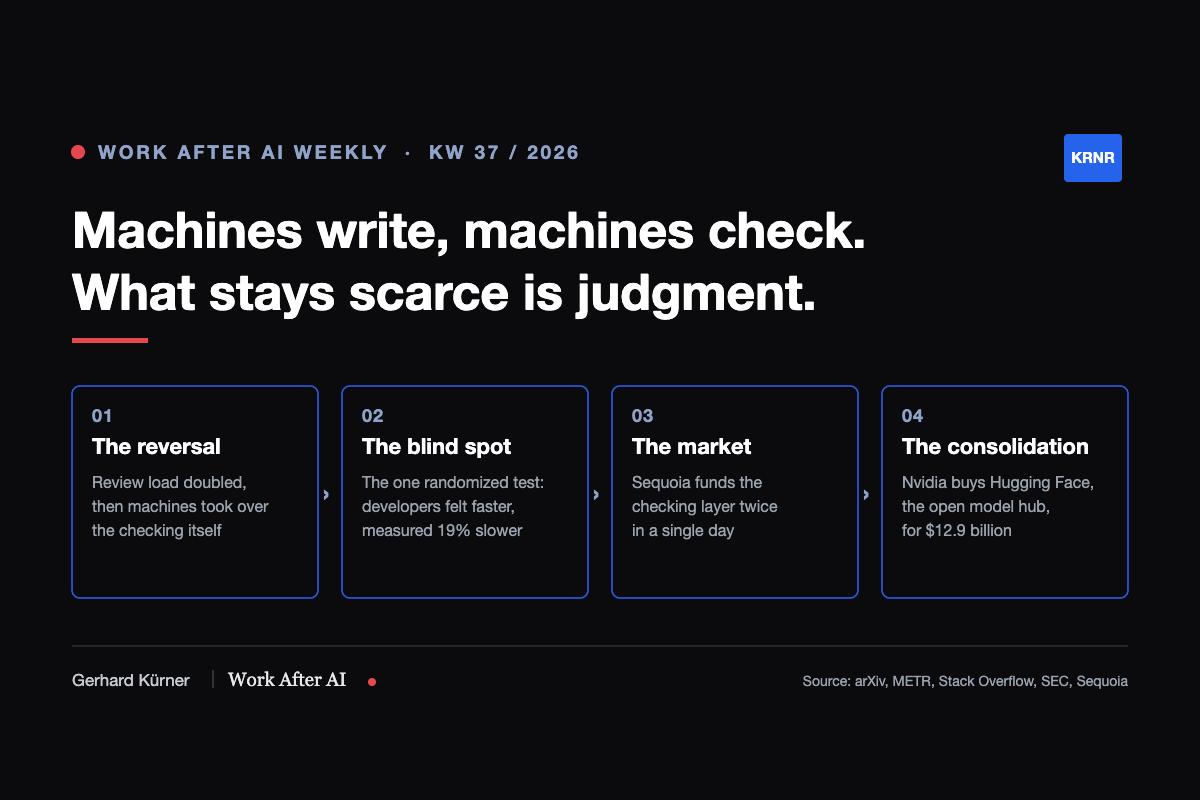
In July, researchers at Stanford and Carnegie Mellon published a longitudinal study whose title says that artificial intelligence writes code faster than humans can review it. Their material is a single mid-sized company that had set itself the goal, in mid-2025, of doubling the merged code changes per engineer, observed across 802 developers and 196,212 change requests from January 2024 to April 2026. By April 2026, changes per head stood at 2.09 times the starting value, a figure that travels with the authors’ own caveat: the measured number was also the company’s official target, so it describes one firm’s push, not a general productivity effect. The finding that matters sits in the reviewing. The load per human reviewer roughly doubled, and then machine review took over and overtook the human kind, while the shares of merged and of reverted changes stayed level, which captures what was caught within the observation window, not what surfaces later. So the sequence was not that human attention became the permanent brake on the machine workforce. The sequence was that human review was the brake, and the next thing to be automated was the brake itself. What limits the system now is not how much a person can read but what can be machine-checked at all, and that is a question of leadership rather than of tooling.
The market is already paying for exactly this layer. On September 1, Sequoia backed two companies in a single day whose entire business is checking: AIR Security, out of stealth with 50 million dollars across two seed rounds for a firewall that vets add-ons, servers and data before they ever reach an AI agent, and Empirik, incubated inside Sequoia itself and launched with 21 million dollars to assess the risk of infrastructure changes before they happen, waving harmless ones through automatically and escalating dangerous ones to people. A day later, Lasso Security raised 30 million dollars for guardrails around models and agents. The verification economy is becoming an industry of its own.
Nobody in this profession can feel whether the machine helps
The one randomized measurement of experienced developers on their own real projects, run by the research organization METR in early 2025, found that the group allowed to use AI tools took 19 percent longer, after expecting to be 24 percent faster, and still believed afterwards that they had been 20 percent faster. Outside experts guessed 39 and 38 percent. The number belongs to its setting, sixteen experienced developers in very large open-source projects with the tool generation of early 2025, and METR has since done something rare in this debate: it publicly graded its own follow-up measurement as very weak evidence, disclosing that thirty to fifty percent of participants held back tasks where they expected the tools to help, and that the headline intervals include zero. METR is also the only source in this week’s bundle with no commercial stake in a positive answer. The lesson is not that the tools slow people down. The lesson is that felt productivity is not a measurement, in the one profession that measures everything else.
Which is why records and referees are getting expensive. In late August, days before this window, Accel led a 99 million dollar employee tender at Linear, the project tracker, at a valuation of 2.5 billion dollars, and justified it with a change in the record itself: by the investor’s account, more than half of the issues in Linear are now written by AI, and the product positions itself as the connective layer between engineers and their digital colleagues. That turns a work-tracking tool into the personnel file of the machine workforce. And AfterQuery, which sells expert-built data for training and evaluating models, is reported to have reached a 3.2 billion dollar valuation five months after being valued at 300 million, reported because the new round’s investors are not fully named. When feeling fails, whoever holds the answer key holds the scarce asset.
Adoption and trust are running apart, and the market consolidates anyway
Google states that in April 2026, 75 percent of new code at the company was machine-generated and approved by engineers, up from 50 percent the previous autumn; the engineers’ approval is part of the claim, so the figure does not describe work taken out of human hands. Anthropic puts the share of merged code written by Claude in its own environment above 80 percent as of May 2026, adding itself that the attribution has gaps and that lines of code measure quantity, not quality. Those are two self-descriptions from different environments by companies that sell the tools being counted, and they do not combine into a trend. Hold them against the profession’s own voice. In the largest survey of the trade, 49,009 respondents in 177 countries in the summer of 2025, 3.1 percent strongly trust the accuracy of these tools and 29.6 percent somewhat trust it, while 26.1 percent somewhat distrust and 19.6 percent strongly distrust it, and 66 percent name answers that are almost right as their biggest frustration. The survey’s host, Stack Overflow, loses traffic to the same tools, which belongs in the picture. Deployment and trust are moving apart, and that distance is the pilot-to-production gap of the whole economy in its most technical form.
The market’s response this week was not to resolve the tension but to own the terrain. Nvidia signed a definitive agreement on September 2 to acquire Hugging Face, the distribution hub through which millions of developers obtain, share and test models, for 12.9 billion dollars, secured by SEC filing and accompanied by a commitment to keep the platform open. The company that sells the machines now also owns the counter where the machine workforce is picked up.
Signals at the margin
Capital for the physical substructure keeps arriving: Andreessen Horowitz raised a 1.1 billion dollar fund for AI hardware on August 28 and expanded its growth fund to 8.5 billion dollars three days later. In the org chart, Uber announced on September 2 that it will cut 3,300 roles, about a tenth of its corporate workforce, with a fifth fewer management positions, framed internally as an answer to too many layers and fragmented ownership; the machine did not appear in the reasoning, the structure did. In governance, a federal judge ruled on August 27 that the Pentagon’s supply-chain-risk label on Anthropic was unlawful retaliation for the company’s refusal to supply fully autonomous weapons uses; the proceedings continue. And the statistics corrected themselves on schedule: the preliminary benchmark revision of August 28 took 79,000 jobs out of the American employment count for March 2026, a tenth of last year’s 911,000, weekly initial claims stood at 206,000, historically low, and the August employment report was due on the day this issue went out and was not available at editorial close, with the consensus expecting 53,000 new jobs. The adjustment still happens at the entrance.
The week at a glance
AIR Security. 50m across two seed rounds (Sep 1); Sequoia (first round lead, per press), Greenoaks, others. A firewall for what reaches the AI agent: the checking layer gets its own budget.
Empirik. 21m launch round (Sep 1); Sequoia (incubator and investor), Canapi, Alumni Ventures. Infrastructure changes get risk-checked before they happen.
Lasso Security. 30m (Sep 2); ClearSky (lead), Entrée Capital, others. Guardrails for models and agents move to millisecond speed.
Linear. 99m employee tender at 2.5b (Aug 26, before the window); Accel (tender lead). The project tracker becomes the work record of machine colleagues.
Wonderful. 550m Series C at 5b (Sep 1); Insight Partners (lead), Index Ventures returning, Salesforce new. The proceeds go into forward-deployed engineers, the human translation layer.
Atira. 17.5m seed incl. pre-seed (Sep 3); Accel (lead), UVC, Fortino, Booom. Specification work between CRM and ERP in industrial sales gets orchestrated.
Hugging Face. 12.9b definitive agreement (Sep 2); Nvidia (acquisition, not a round). The chipmaker buys the counter where developers pick up their models.
Machine Age Fund, Growth Fund V. 1.1b new fund, growth fund to 8.5b (Aug 28 and 31); a16z (own funds). The physical substructure of the machine workforce keeps drawing capital.
AfterQuery. reported 3.2b valuation (Sep 1); Investors not fully disclosed (reported). Expert answer keys for training and evals become a scarce asset.
What this says about capability
My annual report, Work After AI, appears on September 15, and the thesis that runs through it is the capability thesis: what decides the outcome of this technology is not the model but the organization’s ability to work with it. This week gave that thesis its sharpest technical form so far. When machines write the code and machines check the code, the scarce resource is no longer typing, and it is not even reviewing capacity. It is the ability to say in advance what a correct result looks like, and to build that judgment into checks a machine can run. That knowledge lives in the organization, not in the vendor’s model, and the week’s deals show the market paying for the translation work around it. Wonderful, which more than doubled its valuation to 5 billion dollars within six months, names more forward-deployed engineers as a use of proceeds, the people who wire agents into a customer’s actual processes. And Accel led a 17.5 million dollar seed round for Atira of Munich, which takes on the specification-heavy engineering between CRM and ERP for industrial firms, a bet placed squarely on the connection between the machine and a company’s own expertise. The report’s question for every organization follows from there: who in the house decides what the machine may decide, and who says what correct looks like.
Reading the week
None of this is a scoreboard of who invested how much. The deals matter as evidence, and the evidence points one way: the constraint in software work has moved from writing to checking, the checking is being automated in turn, and so the constraint moves on to judgment. How narrow the machine-checkable zone still is was shown by Veracode, itself a vendor of checking software and therefore referee and merchant in one: across more than a hundred models and eighty set tasks, only 55 percent of generated code came out secure, with pass rates of 85.61 and 80.44 percent on the two vulnerability classes that standard checks have covered for years, and 13.53 and 12.03 percent on two classes they never covered. The machines learned what the checks covered, and little beyond. That is the quiet warning under a loud week. Whoever waits to define what correct looks like in their own domain will find that the machine has defined it in the meantime, out of whatever happened to be checkable, and that they did not see it happen.
Gerhard Kürner is CEO of 506.ai, the European platform for Service-as-a-Software and agentic engineering, and author of Work After AI. Around 1,000 conversations with boards, owners, and PE funds across DACH and Europe.
The point about felt productivity vs. actual measurement is so true. Everyone *feels* like they're flying until they spend three hours untangling a weird bug the AI confidently introduced three layers deep.