


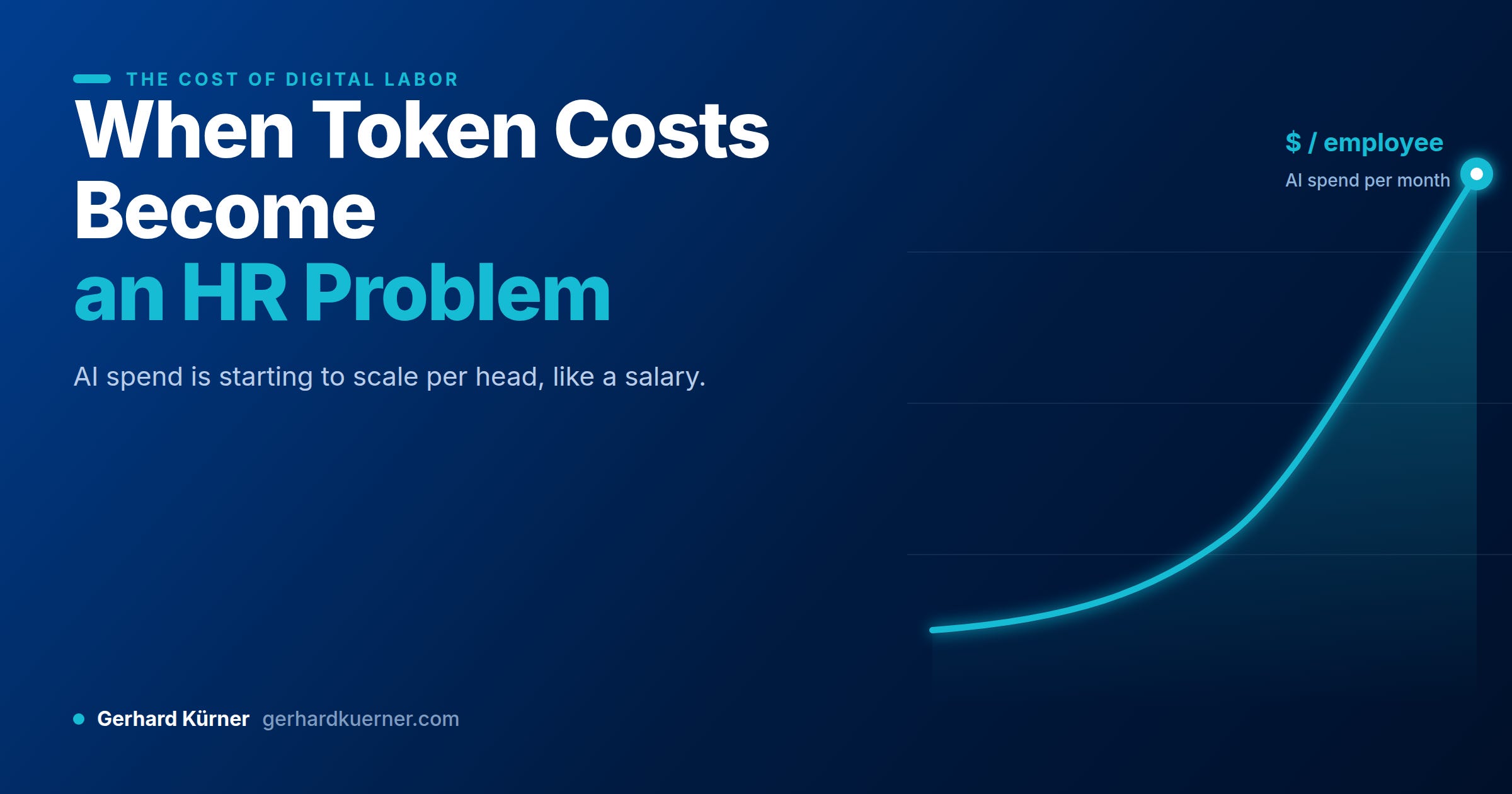
Seventy-five hundred dollars per employee, every month, is what the most AI-forward companies now spend on artificial intelligence. The first reflex is to file that under outlier, the kind of number that belongs to a handful of labs in San Francisco and has nothing to do with a normal business. The reflex is wrong. According to the Ramp AI Index, the same curve is bending upward for everyone, the top ten percent and the median included, and it has steepened fastest in the past few months. What looks like an outlier is a preview of where the rest of the market is heading.
The number itself is not the interesting part. What matters is the shape of it. For the first time, the cost of getting work done by machines is starting to behave like the cost of getting work done by people. It scales with how much work you push onto it, it lands per employee, and that quietly moves it out of the software budget and into territory that finance and human resources have always owned. Boards are still reading this as a line item in IT. That is the mistake this piece is about.
What the Ramp data actually says
Strip away the headline and the Ramp AI Index is making a narrow, precise claim. Across every percentile of company, monthly AI spend per employee is rising, and the curves are accelerating rather than flattening. The most advanced adopters are approaching seventy-five hundred dollars per employee per month. The top ten percent sit around six hundred and thirty. The median is near twelve dollars and has turned sharply upward in the last stretch. The absolute figures matter less than the fact that all three lines bend the same way. The distance between them is a distance in time, not in kind.
What sits inside that spend is the second thing worth reading carefully. Ramp counts LLM subscriptions, coding agents, API tokens, and GPU cloud. None of that is software in the sense a CFO grew up with. It is the operating cost of output that used to require a person. I have watched this line appear in client after client over the past two years. Two years ago it did not exist. Today it is a budget line that grows with usage rather than with seats, and almost no one has decided who owns it.
The cost scales like payroll, not like software
Here is the uncomfortable equation underneath. Per-seat software has a ceiling built into it. You pay a flat fee for each employee, and your bill stops climbing when your headcount does. Usage-metered intelligence has no such ceiling. The bill climbs with how much work the digital teammate does, and the leaders are deliberately pushing more work onto it every quarter. So the more capable your AI colleague becomes, the more it costs to run, and that cost arrives per employee, in the same shape as a wage.
That is precisely why this turns into a human resources problem rather than a procurement footnote. When the cost of getting work done scales with output and lands per head, it obeys the same budget logic as labor. The machine that absorbs a task does not arrive with a license fee. It arrives with an operating cost that behaves like a salary, and it sits next to the salaries on the same page.
This is the part most boards have not yet put together. The same force that lets a company take cost out of its human workforce creates a new variable cost that grows with use. Human resource cost falls on one side of the ledger while operating expense rises on the other. The net is not an automatic saving. It is a substitution, and whether it improves the margin or quietly erodes it depends entirely on the unit price of the machine work. That single number, the price of the underlying intelligence, decides whether the trade is brilliant or ruinous.
No lock-in is the lever boards are not pulling
The second chart in the Ramp data is the one that should change how every owner thinks about this. Unlike software, artificial intelligence carries no vendor lock-in, and the most advanced adopters know it. The top one percent of companies use a median of eight different AI vendors. The top ten percent use five. The median uses two. The leaders are not married to a single provider. They route each piece of work to whichever model does it best and cheapest, and they switch without the migration pain that a per-seat software contract was designed to inflict.
That is the lever almost no board is pulling. If AI cost is a per-employee operating expense that scales with use, then the unit price of the model is the largest single determinant of whether that line stays sane. And the work itself is portable in a way software licenses never were.
Consider how large the lever actually is. GLM-5.2, the open-weight model from the Chinese lab Z.ai, was trained entirely on Huawei chips under US sanctions and released in mid-June. On coding it matches the closed flagships, scoring 74.4 on FrontierSWE against Claude Opus 4.8 at 75.1, and beating GPT-5.5 on SWE-bench Pro. It does that work at roughly one sixth of the output price, $4.40 against $25.00 per million tokens. The early benchmarks came partly from the vendor and independent verification is still under way, so the exact ranking will move over the coming months. The price gap of roughly six to one will hold. The same coding output, for a fraction of the per-token cost, and it drops into Anthropic’s own Claude Code by changing two environment variables. You keep the interface your engineers already use, and you swap the engine underneath. The cost line that boards treat as fixed is in fact the most negotiable line they have.
The variable nobody put in the model: who controls access
There is a catch that turns this from a procurement question into a risk question. With AI, for the first time, the access to a tool your business depends on can be switched off by someone other than you. In mid-June a US export-control directive barred foreign users from Anthropic’s strongest Fable-class model, and those models went offline. A capability that sits inside your daily workflow can disappear overnight, by directive, with no breach of contract and no clause that procurement could have negotiated away.
So the per-employee AI cost line carries a property no payroll line has ever had. It is a single-supplier dependency on a capability that a vendor or a government can revoke. That reframes the choice of model from cheapest per token to something sharper. Can this capability be taken away from me, and what happens to the work when it is.
This is where open weights and sovereign hosting stop being an ideological preference and become ordinary balance-sheet hygiene. An open-weight model under a permissive license, running on European sovereign infrastructure, is a cost lever and a continuity guarantee at once. Scaleway began hosting GLM-5.2 in Paris in late June as the first sovereign European provider to do so, which means the weights cannot be revoked and no line of code leaves the data center. For an owner or a board, the AI line has become two questions at the same time, a margin question and a dependency question, and pricing either one wrong is pricing the business wrong.
The companies that already see it
Read the Ramp curves again with this in mind and the leaders look different. They are not reckless spenders. They are companies that already treat machine intelligence as a workforce, with the same discipline of unit economics and multi-sourcing that finance has always applied to labor and to suppliers. That is why they run eight vendors and not one. They are managing a cost that scales per head, and they refuse to let any single provider own either their margin or their continuity.
The question has quietly stopped being how much AI costs. It has become who inside the company governs it like the workforce it is turning into. The boards that keep this in IT, treating it as a subscription to renew rather than a labor cost to manage, are not saving themselves the trouble. They are deferring a decision while the line keeps growing.
This is the kind of cost that does its growing while no one is watching. Whoever waits will look up in two years to find that the largest variable cost in the business matured into a payroll line, controlled by a supplier they never chose to depend on, and they never saw it coming.
Gerhard Kürner is CEO of 506.ai, the European platform for Service-as-a-Software and agentic engineering.
Sources: Ramp AI Index, z.ai (GLM-5.2), Scaleway, Anthropic (Fable-Direktive), VentureBeat.