


Every Friday I read the week's signals from two sources, the investments of early-stage investors and the findings of research institutions, the same evidence base my annual report on AI and work is built on. The investors are never the story. Their decisions, and increasingly the operating data coming out of real deployments, are simply among the earliest signals of how work, organizations and enterprise software are changing.
The most important signal this week was not a funding round but a measurement. All three large model providers have now published traffic data on how their systems are actually used at work, and the newest series points at something the job debate has largely missed. The question of the moment is not how much work moves to the machine. It is how fast work moves between people, across job boundaries that were drawn for a world of expensive handoffs.
The job description dissolves at the edges first
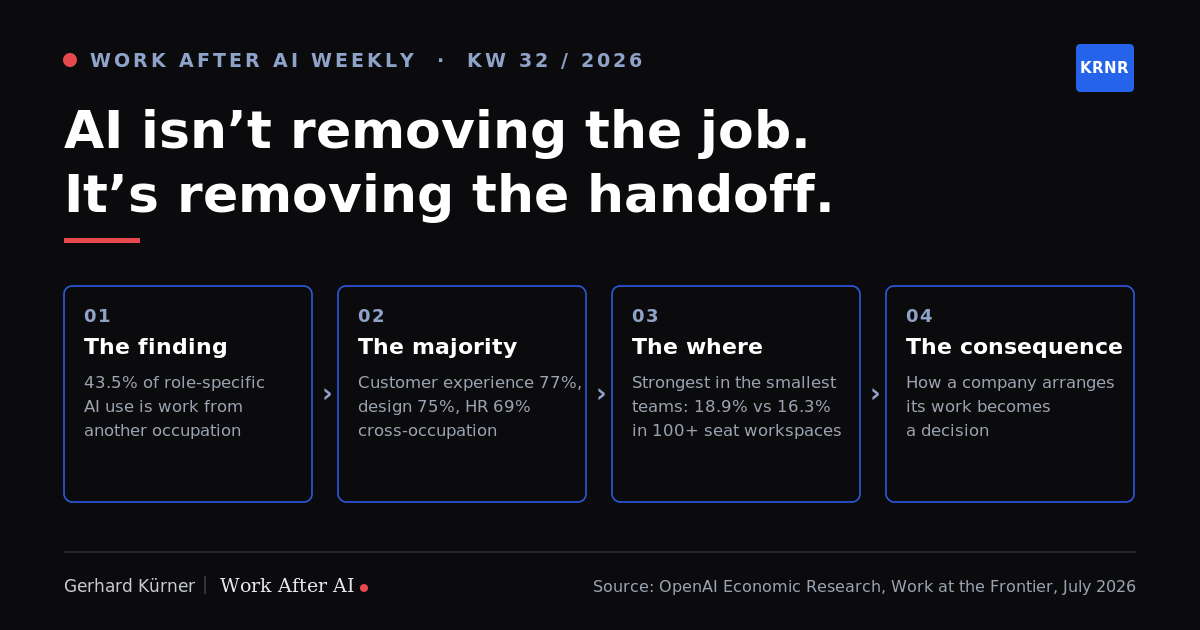
OpenAI published Work at the Frontier on July 27, the first edition of an announced ongoing series, classifying more than 800,000 work-related messages of American ChatGPT business users against the official O*NET occupation database. The finding that matters: 43.5 percent of occupation-specific usage concerns tasks that historically belong to a different occupation. In customer experience, design and human resources, cross-occupation work is not the exception but the majority of role-specific use, at 77, 75 and 69 percent. And the pattern is strongest where teams are smallest. In workspaces with two to five seats, the cross-occupation share of typical users reaches 18.9 percent, against 16.3 percent above one hundred seats. Where no specialist is within reach, the task is done by the person in whom the need arises, with a digital colleague covering the missing craft.
This is a provider self-study and has to be read as one. OpenAI measures messages, not hours or outcomes, discloses no survey period, and has an obvious interest in a story of expansion rather than replacement. But it is the third traffic-data series after Anthropic and Google, and on direction the three now agree: the boundaries between jobs are moving faster than the jobs themselves are moving to the machine. The first measurable organizational effect of this technology is the saved handoff, not the replaced position.
You can see the market building for exactly this. Madrona led a 5.7 million dollar seed round on July 29 for Polar, a browser made for knowledge work, in which one person hands tasks in sales, recruiting, marketing and research to AI agents working from the open tabs. Two weeks earlier, and before this issue's window, the same firm led a 21 million dollar seed for Thira, founded by the Apptio founders around the idea of a back office that runs itself. One investment puts adjacent domains into the hands of the individual worker, the other removes an entire internal handoff chain. Both are bets on the same arithmetic.
The machine holds the conversation, and the handoff decides the outcome
The second signal of the week comes from operating data rather than usage statistics. Andreessen Horowitz published an analysis built on the operations of its portfolio company EliseAI, whose dialog systems handle tenant communication for, by the company's own account, roughly one in six US rental apartments. The median machine-led phone call has grown from 46 seconds in mid 2023 to around 100 seconds at the end of 2025, which is exactly the duration of calls handled by people. The artificial voice no longer just takes the call, it carries the conversation. The disclosure matters here: a16z led EliseAI's Series E, the quoted commentator sits on the company's board, and every number is single-source operator data.
The deeper finding is the seam. When the machine's conversation is followed by an immediate handoff to a human, 26 percent of prospective tenants go on to sign a lease. When three days pass, the rate falls below 9 percent. The value of a digital workforce in customer dialog is created or destroyed at the moment of transfer between machine and human. Where this leaves the software industry was spelled out on Bloomberg TV on July 28 by Sapphire Ventures partner Cathy Gao: the next winners will not build foundation models at all, because the value is moving into AI for specific industries such as healthcare, real estate and legal work. The conversation layer is becoming infrastructure. The margin sits in the domain.
The capital behind the buildout starts pricing proof
The third signal came from the public markets, in the heaviest earnings week of the year. Microsoft reported Azure up 43 percent in constant currency and gained around eight percent. Amazon reported AWS growing 37 percent, its fastest pace since 2021, raised its 2026 capital spending outlook toward 220 billion dollars and gained around ten percent. Meta raised its capex guidance to between 130 and 145 billion dollars while free cash flow collapsed by 91 percent, and lost around eight percent. The pattern is worth stating plainly: the market has stopped paying for ambition alone and started separating AI spending backed by demonstrated demand from AI spending running ahead of it.
The financing structure is shifting with it. Meta and BlackRock announced a 14 billion dollar joint venture for a one-gigawatt data center campus in El Paso, in which BlackRock funds hold 80 percent and Meta leases the campus back. When asset managers rather than tech balance sheets own the buildings, the infrastructure of machine labor becomes its own asset class, with its own return requirements.
Signals at the margin
Energy: Nvidia is negotiating a financing backstop of up to 250 billion dollars for OpenAI's planned ten-gigawatt campus in Ohio, first reported by the Wall Street Journal. The talks are not concluded, but the order of magnitude marks where the ceiling of this buildout currently sits.
Defense: Anduril is reportedly in talks to raise at a valuation around 100 billion dollars, per Reuters, more than three times its mark from May last year. Defense software remains the fastest repricing category in private markets.
Distribution: The Financial Times' Free Lunch column argued on July 26 that wages and productivity look set to diverge further in the first AI years. The long series behind that worry is stark on its own: since 1979, US net productivity has grown 92.4 percent against 33.6 percent for the hourly pay of typical workers, per the Economic Policy Institute. Whether the machine colleague widens or narrows that gap is a design question, not a law of nature.
The week at a glance
Polar : 5.7M seed (July 29), led by Madrona. A browser in which knowledge workers hand tasks across domains to AI agents.
Thira : 21M seed (July 14, before the window), led by Madrona with FUSE. The back office as the first fully machine-run domain.
Chai Discovery : 400M Series C at a 3.8B valuation (July 14, before the window), led by Index, with Sapphire among the new investors. AI-designed antibodies reach the programs of large pharma companies.
Helsing : 1.8B Series E at an 18B valuation (July 13, before the window), with Dragoneer, Lightspeed, Iconiq and a first check from Disruptive. Europe's software-defined defense gets late-stage US capital.
The org chart is turning from an inheritance into a decision
Put the week's signals side by side and they describe one movement. Usage data shows individuals absorbing the tasks of neighboring professions. The tools being financed are built to let small units carry whole domains end to end, with digital teammates covering the adjacent skills. And the EliseAI numbers show where the risk concentrates: at the seams, where work passes between machine and human. Organizations were drawn the way they are because handoffs between specialists were expensive. When the handoff becomes cheap, the inherited org chart loses its reason, and how a company arranges its work becomes a live decision rather than a legacy.
This is one of the questions at the center of Work After AI, my annual report on artificial intelligence and work, which appears this fall: how organizations will order their work when job boundaries move faster than jobs, and why the outcome is decided not by what the models can do but by the capability of the individual company to make them productive on its own knowledge and processes. The specialist does not disappear in that picture. Judgment and final review concentrate where the expertise sits. What disappears is the queue in front of the specialist.
As always, none of this is a scoreboard of who deployed the most capital. The rounds and the operating data matter as evidence for a thesis, and this week the evidence came from three independent directions at once: usage statistics, deployment data from a mass market, and the priorities of the capital markets. The job description was a child of expensive handoffs. That era is ending quietly, in the daily traffic of work itself, and whoever waits for an official announcement will find that the reorganization was already there, and that they did not see it coming.
Gerhard Kürner is CEO of 506.ai, the European platform for Service-as-a-Software and agentic engineering, and author of Work After AI. Around 1,000 conversations with boards, owners, and PE funds across DACH and Europe.